
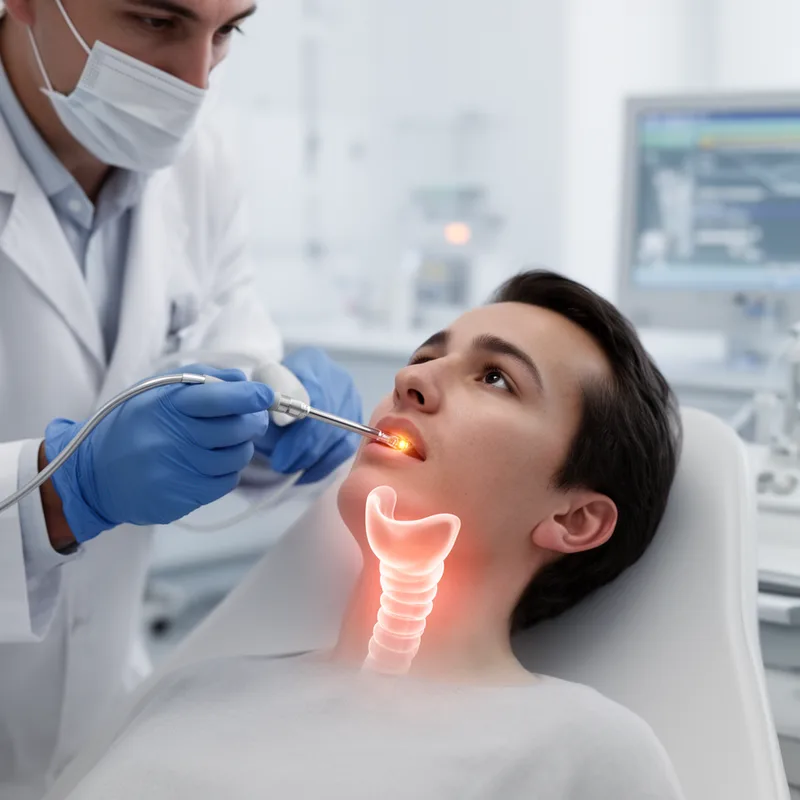
tracheoscopy
- noun
- /trəˈkiːəˌskɑːpi/
- Specialized
- Tracheoscopy can be performed fairly routinely in the office setting without the need for additional anesthesia—that is, an amount beyond what is required for standard nasolaryngoscopy.
- perform tracheoscopy
Examples
-
Fiberoptic laryngoscopy and tracheoscopy should also be performed to rule out any tracheal compression, deviation, or invasion.
Academic text (2006) -
Tracheoscopy performed via the tracheotomy opening revealed a normal distal airway and subglottis.
Academic text (2006) -
At the conclusion of the standard FEES protocol, tracheoscopy is performed.
Academic text (2004) -
Tracheoscopy alone.
Academic text (2004) -
A patient who cannot tolerate tracheoscopy is asked to perform a throat clear, which will bring any aspirated tracheal material back into the laryngopharynx.
Academic text (2004) -
The doctor performed a tracheoscopy to examine the patient's airway.
-
During the tracheoscopy, the specialist carefully inspected the trachea for any abnormalities.
-
Before the surgery, a tracheoscopy was necessary to evaluate the patient's breathing passages.
How Invasive
- Specialized
 3
9.1
3
9.1


- Specialized
9
7.5
- Specialized
- Specialized
Surface Forms
Morphology
tracheoscopy = trachea (semi-transparent) = tracheo + scopy
Formed from the combining form 'tracheo-' (from 'trachea') plus the technical suffix '-scopy' meaning 'visual examination', which is understandable to those familiar with medical terms but not to average learners.
Etymology
Tracheoscopy comes from the Greek parts trachea meaning 'windpipe' and -scopy meaning 'to look'. So a tracheoscopy is a medical exam that lets a doctor look inside the windpipe to find problems.