
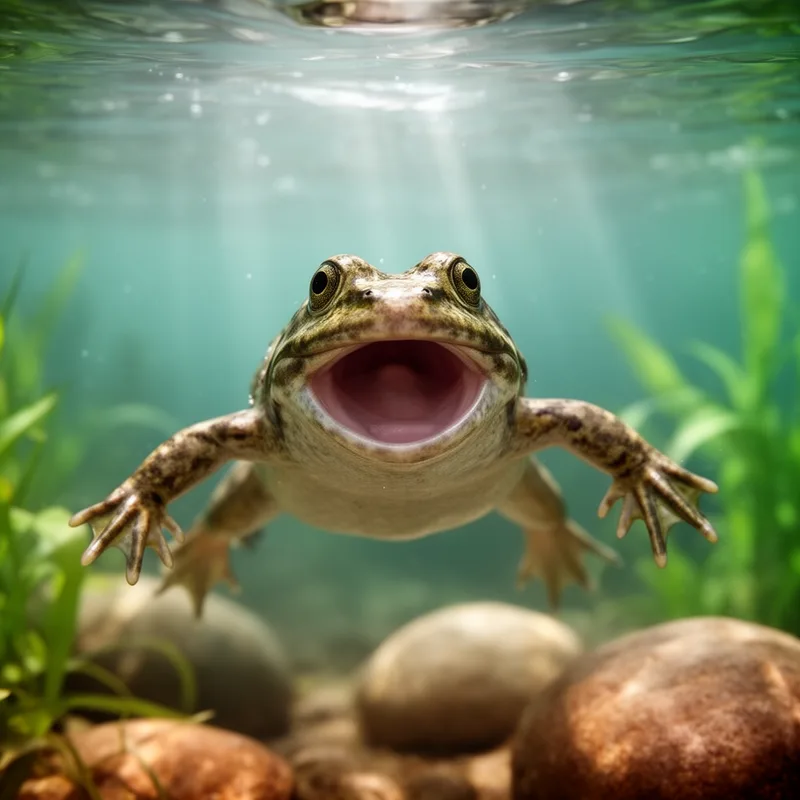
tongueless frog
- noun
- US
- Unlike most amphibians, the tongueless frog cannot use a tongue to catch its prey.
Examples
-
The tongueless frog adapts well to a fully aquatic lifestyle in its native African rivers.
-
Scientists were surprised to find a population of tongueless frogs thriving in Panama’s wetland reserves.
-
The tongueless frog is a fascinating creature.
-
Did you know the tongueless frogs live in water?
-
The tongueless frog adapts well to life in the wetlands, where it swims gracefully without a tongue.
-
Scientists were surprised to discover a thriving population of tongueless frogs in the freshwater rivers of Africa.
-
Unlike other frogs, the tongueless frog catches its prey by using its unique jaw structure instead of a tongue.
Synonyms


 1
6.7
1
6.7
A water frog from Africa without a tongue that has claws and is often used in labs

A common African water frog with clawed toes used in labs
Surface Forms
Morphology
The meaning 'a frog lacking a tongue' is directly and transparently derived from combining 'tongueless' (having no tongue) with 'frog' (an amphibian). This adjective + noun composition is literal and follows common cross-linguistic patterns, so a B1 learner who knows both constituents would readily understand the MWE.
Etymology
Tongueless frog is a name made from tongueless and frog, and it gives a clear picture of a frog with 'no tongue'. Because this animal lives mostly in water and cannot use a tongue to catch food, the name points to that real, special feature.