

tin whistle


 1
4.2
1
4.2
- noun
- /tɪn ˈwɪsəl/
- The sound of the tin whistle filled the air as the folk band performed traditional songs at the village fair.
- play a tin whistle
Examples
-
At the festival, children gathered around to listen to the musician play a beautiful tune on his tin whistle.
-
Now, try to imagine me there, walking along, playing a tin whistle just as happy as can be.
-
A child blows into a last tin whistle.
Fiction book (1997) -
Taking the tin whistle from his lips, Bertrand flicked it several times, trying to rid it of water.
Fiction book (2001) -
Attendees acquire an ability to function as tradition-bearers; they confide their purpose in statements such as, "If I know how to perform a tune on the tin whistle, or if I'm able to dance the Connemara set, I'll be closer to my roots."
Academic text (2001) -
BOSTON Gaelic Roots Festival, JUN 20: Boston College resonates with the sound of tin whistles and harps and the staccato of step dancing during a weeklong music, song, and dance school and festival.
Fiction book (1999) -
After lunch, they took out their instruments, including a tin whistle, to play some cheerful folk music by the river.
Synonyms
 22
2.0
22
2.0
A small simple flute used in folk music
 1
7.4
1
7.4
A small metal flute used to play simple folk tunes
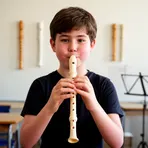
A simple wind instrument like a recorder that you blow into
How Simple

Surface Forms
Morphology
The meaning is directly compositional: 'tin' names the material and 'whistle' names the instrument, so a B1 learner who knows both words can infer it is a whistle made of tin (a simple, inexpensive flute). Material+object noun phrases are a common, transparent construction cross-linguistically, so the expression should be immediately understandable to learners who know the constituents.
Etymology
Tin whistle comes from the cheap metal many early makers used (tin) and the clear, high sound the little flute makes (whistle). Because these small, easy-to-buy metal flutes were common in folk music and taught to children, the name now means 'a simple, inexpensive metal flute'.