
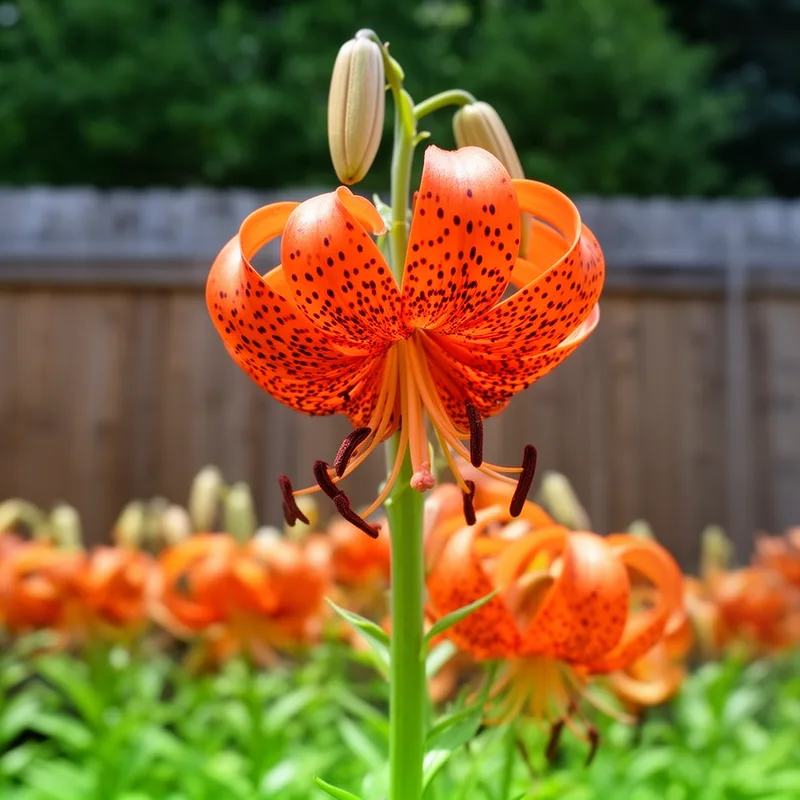
tiger lily
 1
4.6
1
4.6

- noun
- /ˈtaɪɡər ˈlɪli/
- She carefully arranged the tiger lilies in the vase, admiring their bold and beautiful petals.
- pink tiger lilies
- orange tiger lilies
- tiger lily stem
Examples
-
She planted dahlias, gladiolas, mums, peonies, tiger lilies, lupines, and lots and lots of tulips.
Blog text (4) -
Rooted it among the tiger lilies.
Fiction book (1998) -
"A tiger lily stem," Arna says.
Fiction book (1994) -
I am a tea rose, a purple iris, and often a long-stem tiger lily.
Fiction book (1991) -
Tiger lilies love the dandelions In the golden afternoon
-
I stoop to rescue the handful of tiger lilies floating by the dock.
Fiction book (1993) -
Hadn't he helped her grandmother plant the orange-speckled tiger lilies that adorned the east and west sides of the house?
Fiction book (1993) -
I see even the tiger lily, with its bulbs, growing by the roadside far from houses (near Leighton's graveyard).
Blog text (6) -
In the colorful garden, the vibrant tiger lilies stood out with their striking orange and black spots.
-
The tiger lily is known for its unique appearance, featuring large, recurved petals that are often orange with dark spots.
Synonyms
 165
1.0
165
1.0
A tall plant with large, showy bell-shaped flowers often grown in gardens
A garden plant with large orange flowers with black spots called tiger lily
A tall plant with bright orange, spotted flowers whose petals bend backwards
Surface Forms
Morphology
tiger + lily
As a noun compound, 'tiger' functions as a modifier of 'lily' indicating a lily that has tiger-like coloration or patterning; a B1 learner who knows 'tiger' (the animal) and 'lily' (the flower) can infer this meaning directly. Naming plants by resemblance to animals is common cross-linguistically, so the composition is straightforward and transparent.
Etymology
Tiger lily gets its name from the flower's look: its bright orange petals have dark spots like a tiger's coat. That's why the words tiger and lily together now mean 'a spotted, colorful lily'.