
thyroglobulin


 1
9.9
- noun
- /ˌθaɪroʊˈɡlɒb.jʊ.lɪn/
- Specialized
- Serum thyroglobulin levels can be measured during follow-up to screen for recurrent or metastatic disease in patients with well-differentiated cancer.
- thyroglobulin level
Examples
-
On routine follow-up, she was found to have an elevated thyroglobulin level (15.2 ng/ml), and she was referred to our department.
Academic text (2005) -
An unambiguous advantage of total thyroidectomy is that it allows for precise follow-up with thyroglobulin and radioactive iodine scanning.
Academic text (2002) -
The patient's postoperative thyroglobulin level was 0.
Academic text (2005) -
Histochemical staining for cytokeratin was negative, but strongly positive for thyroglobulin.
Academic text (1998) -
The way to find out is to get your thyroid antibodies tested: TPO and thyroglobulin.
Blog text (31) -
The doctor's report showed that the patient's thyroglobulin level was normal after treatment.
-
Measuring thyroglobulin levels is crucial for monitoring thyroid cancer patients.
-
After the surgery, the specialist checked the thyroglobulin levels to ensure there was no recurrence of the disease.
Surface Forms
Morphology
Etymology
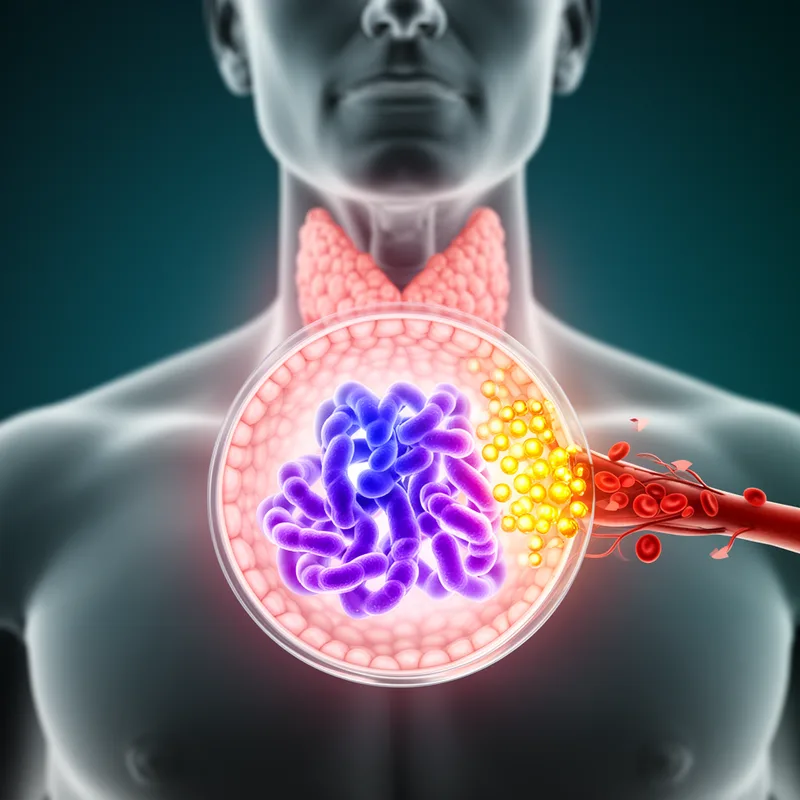
Thyroglobulin breaks into two parts: thyro-, like thyroid, which comes from a word for 'shield' because the gland is shield-shaped, and globulin, from a word for a 'small ball' used for a type of protein. So, thyroglobulin is a 'small-ball' protein made in the thyroid that helps make thyroid hormones.