
thylakoid


 1
9.9
- noun
- /ˈθaɪləˌkɔɪd/
- Specialized
- Alternatively, nonphotochemical quenching occurs when there is a lack of available resources to support photochemical quenching and the subsequent dark reaction, which results in an accumulation of H+ ions and subsequent acidification of the thylakoid membrane.
- thylakoid membrane
Examples
-
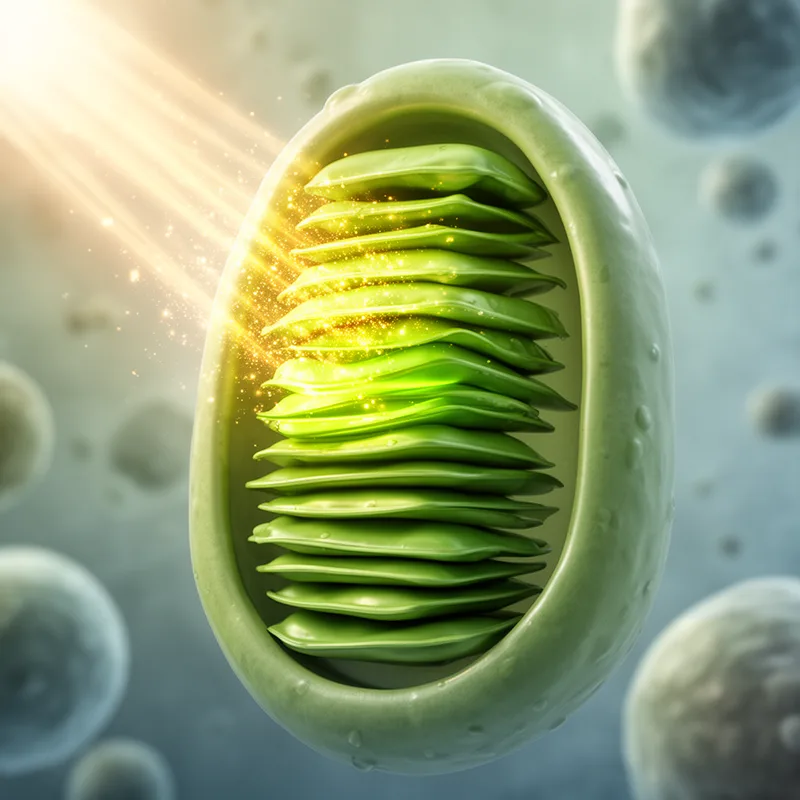
The structure of the thylakoid includes stacked sacs that facilitate the conversion of sunlight into chemical energy.
-
You can see the thylakoid membranes inside.
-
All right, So thylakoid membrane, stroma side, lumen side.
-
My research experience was mainly on thylakoid stacking investigation and, although I never worked on bacteria, sucrose gradients, or extraction techniques, he chose me to work with him for 2 years at Odense University in Denmark.
Academic text (2018) -
In chloroplasts, the thylakoid membranes are essential for the light-dependent reactions of photosynthesis.
-
Light energy is captured by pigments in the thylakoid membranes during the photosynthetic process.
Surface Forms
Morphology
thylakoid = thylako (opaque) = thylako + oid
Formed from the scientific combining form 'thylako-' plus the suffix '-oid'; these are not productive or familiar standalone English morphemes for average learners, so the meaning is not transparently derivable from common vocabulary.
Etymology
Thylakoid comes from the Greek root thylakos, meaning 'sac' or 'pouch', plus the ending -oid, meaning 'like' (seen in asteroid). So a thylakoid is a 'sac-like' pouch inside chloroplasts where the light part of photosynthesis happens.