
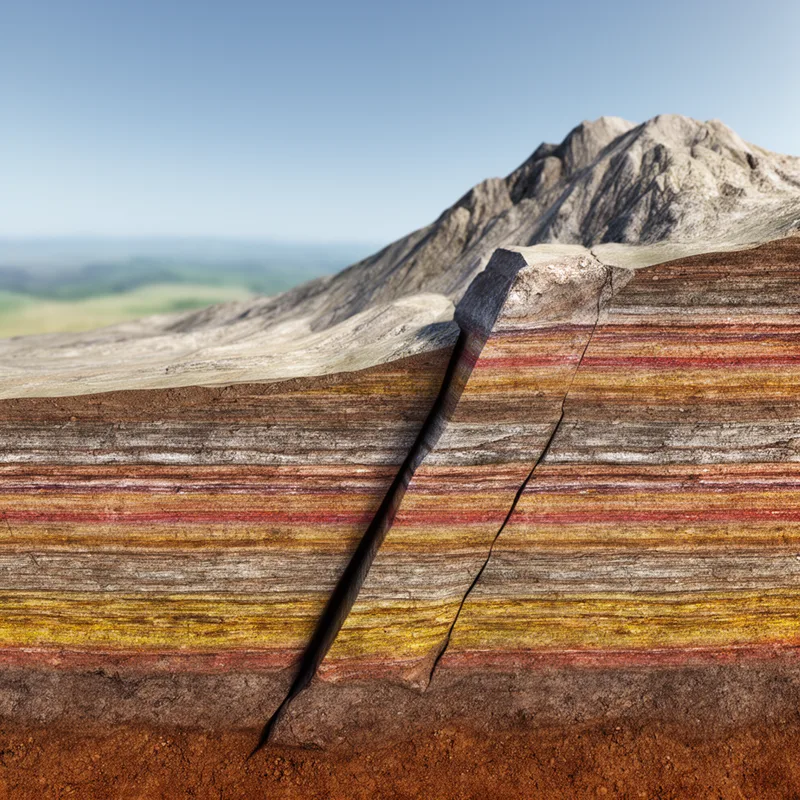
thrust fault


 1
8.1
1
8.1
- noun
- /θrʌst fɔlt/
- Specialized
- The region is known for its complex geology, including several active thrust faults that contribute to seismic activity.
Examples
-
During the last major earthquake, geologists identified a new thrust fault that had formed deep underground.
-
That it'll just be a blind thrust fault.
-
"How did a planet the size of Mercury produce these big thrust faults?
Academic text (2007) -
I am not sure if this approach would work with a 90-degree thrust fault like the Newport-Inglewood is.
Blog text (18) -
The San Andreas was a strike-slip fault, whereas the Sierra Madre was a thrust fault.
Fiction book (1999) -
Teddy was particularly anxious about hidden faults; the Northridge earthquake had been the result of a hidden thrust fault, only discovered after the fact.
Fiction book (1999) -
Researchers studied the effects of tectonic pressure on the thrust fault to understand better how mountains are formed.
Synonyms
A break in rock where one side moves up when the land is pushed together

A break in rock where strong sideways force pushes one rock layer up and over another
Surface Forms
Morphology
The phrase combines 'thrust' (a pushing/upward force) with 'fault' (a tectonic fracture), so its meaning—a fault produced by compressive/upward movement—is compositionally inferable from the parts. However, this is a technical geological term using a domain-specific sense of 'thrust' that a B1 learner may not know, so the relation is only partially predictable without subject-matter knowledge.
Etymology
The term thrust fault begins with the image of a strong thrust, a big 'push' that makes rock on one side of a fault, a 'break' in the ground, slide up and over the other side. That's why a thrust fault means the upper rocks have been pushed over the lower rocks, often making the land 'rise'.