
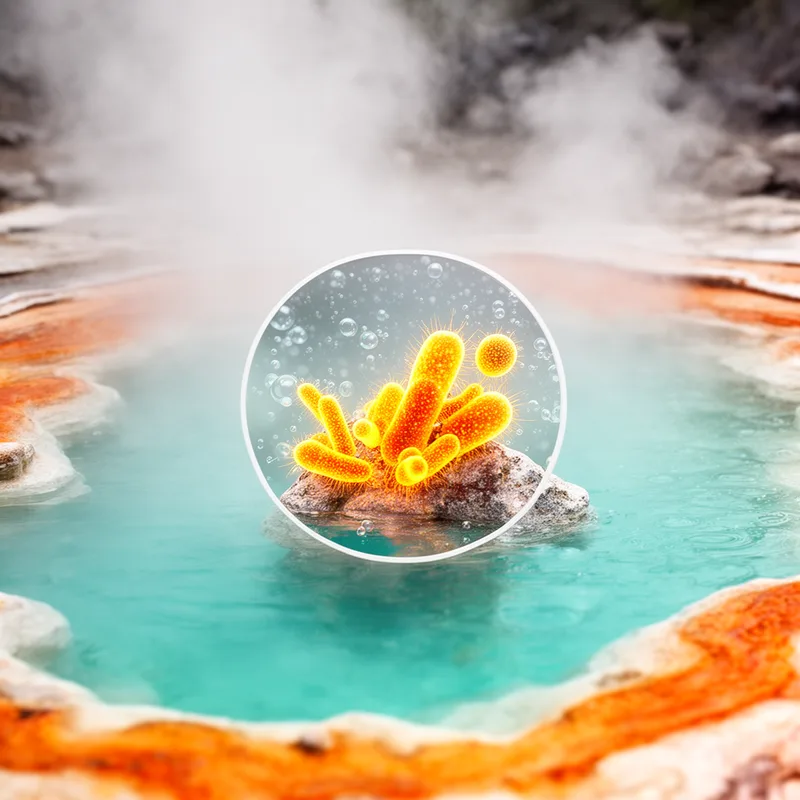
thermophile


 1
8.9
- noun
- /ˈθɜrməˌfaɪl/
- Specialized
- Thermus aquaticus is a thermophile that has generated immense wealth, both economic and societal.
- thermophile M. thermolithotrophicus
Examples
-
You might have thought its cousins in the microbe world, the archaea and thermophiles, would have been grateful.
Fiction book (1999) -
A year later, the park hosted an international thermophile conference, the first one to focus on Yellowstone's microbial diversity.
Academic text (1996) -
Then we will seed the crust with thermophiles, microbes that live at steam temperature.
Fiction book (1998) -
It is the first published report, they say, of proteins from thermophiles being stabilized by pressure.
Academic text (1994) -
Thermophiles, which have mostly been collected since the 1980s, are heat lovers that do well at temperatures above 70 degrees Celsius.
Academic text (1994) -
The thermophiles will convert all the molecules in the soil to forms compatible with human physiology, while outgrowing the few native organisms that remain.
Fiction book (1998) -
For example, thermophiles grow at temperatures greater than 45 Celsius, and hyperthermophiles grow best at temperatures above water's sea-level boiling point of 100 Celsius.
Academic text (2000) -
A year later, the park hosted an international thermophile conference, the first one to focus on Yellowstone's microbial diversity.
-
Then we will seed the crust with thermophiles, microbes that live at steam temperature.
-
Thermus aquaticus is a thermophile that has generated immense wealth, both economic and societal.
Antonyms

How Heat-Loving

Surface Forms
Morphology
thermophile = thermo + phile
The meaning is fairly direct as 'heat-loving', but it relies on classical combining forms rather than fully transparent everyday English words.
Etymology
Thermophile comes from two Greek parts: thermo- meaning 'heat' and -phile meaning 'lover' or 'friend'. So a thermophile is a microbe that 'loves' heat and grows best in very hot places like hot springs.