
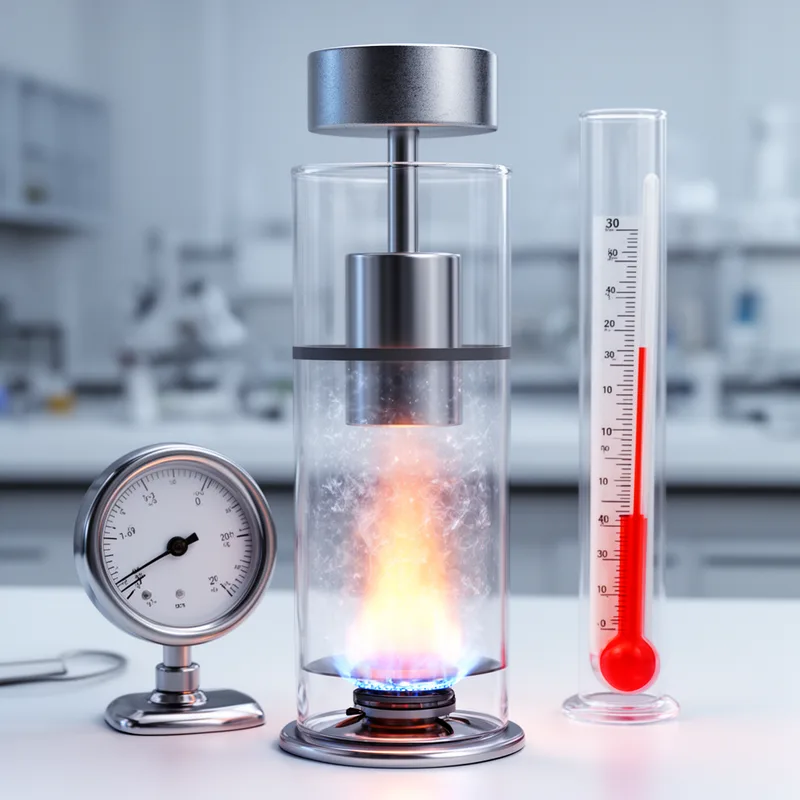
thermodynamic
 4
7.0

- adjective
- /ˌθɜrməʊdaɪˈnæmɪk/
- Specialized
- In this section, we calculate some basic thermodynamic quantities like the temperature and the entropy.
- thermodynamic equilibrium
- thermodynamic cycle
- thermodynamic properties
Loading YouTube…
Watch on YouTubeWe use the simplest kind of thermodynamic identities.
- We use the simplest kind of thermodynamic identities.
- So it's not until you emerge at the thermodynamic level that there's an arrow of time.
- They've left quantum computing to help us build what we call actually a thermodynamic computer.
- The memory of the thermodynamic principles and the calculus principles are similarly encoded into your nervous system.
Examples
-
The magnetic field is applied and removed at different stages of the thermodynamic cycle.
Academic text (1994) -
The previous discussion of fuel cell performance refers to the ideal thermodynamic efficiency.
Academic text (1994) -
And then they assume further that there is a thermodynamic loss in their device.
-
A property which results in the same relation for the thermodynamic temperature as well.
Academic text (2018) -
The choice of the ensemble should not matter for thermodynamic properties.
-
Absolute zero is the null point of the thermodynamic temperature scale, also called absolute temperature.
Blog text (29) -
The horizon structure provides the required information in order to obtain thermodynamic properties like temperature and entropy.
Academic text (2018) -
However, a thermodynamic study was carried out to check the feasibility of the biosorption process as well.
Academic text (2015) -
Even a single molecule per 1000 neutral atoms leads to a dramatic change in the thermodynamic behavior of the gas.
Academic text (2011) -
The refrigerator operates on thermodynamic principles to keep food fresh.
Synonyms

 1
8.2
Relating to heat and energy changes in systems like engines
Surface Forms
Morphology
Etymology
Thermodynamic comes from Greek parts thermo- meaning 'heat' and dynamic meaning 'power' or 'movement', and you can see thermo- in thermometer. So thermodynamic is about the 'power' or movement of heat, which is why it describes how heat relates to energy and work.