

theory of inheritance
- noun
- /ˈθiəri əv ɪnˈhɛrɪtəns/
- Specialized
 :
teoría de la herencia
:
teoría de la herencia
- Mendel's experiments led to the establishment of the theory of inheritance, explaining how traits are passed from parents to offspring.
Examples
-
The modern theory of evolution is often interpreted to be a synthesis in the 1930s of Mendel's theory of inheritance with Darwin's theory of natural selection (along with natural history).
Blog text (16) -
The chromosomal theory of inheritance doesn't predict that you'll get and it predicts that you will not get the non parental phenotypes.
-
2) Eugenics had a firm basis in the genetic theory of inheritance.
Blog text (16) -
Scientific research has provided strong evidence to support the theory of inheritance, showing how genetic traits are transmitted across generations.
-
The theory of inheritance helps us understand why certain diseases are hereditary and can be passed from parents to their children.
Synonyms
 123
3.7
123
3.7

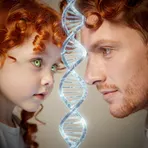
The study of how traits like eye colour or height pass from parents to children
 9
5.8
9
5.8
Parents pass physical and mental traits to their children through genes
 7
4.9
7
4.9
The way children get physical traits from their parents
How Accepted
- Specialized
206
5.0
 ∞
3.2
∞
3.2
- Specialized
817
2.9
138
6.1
288
4.8
Surface Forms
Morphology
theory + of + inheritance
The phrase is fully compositional: 'theory' (set of ideas) combined with 'inheritance' (passing of traits) linked by the preposition 'of' yields the meaning of a theory explaining how traits are passed on. This construction is cross-linguistically common and follows standard noun + of + noun composition, so a B1 learner who knows the constituents will readily infer the meaning.
Etymology
Theory of inheritance comes from early scientists like Gregor Mendel, who grew peas and watched how traits like seed colour moved from parent plants to new plants. The word inheritance was used like things passed down in a family, so the phrase means an idea that explains how physical traits are 'passed on' from parents to children.