

the Venerable Bede
- proper noun
- Formal
- On his right was the Venerable Tenzin Dechen, who also spoke some English.
Examples
-
When Davudi completed his speech, Klaus Schwab, the venerable chairman of the World Economic Forum and prominent philanthropist, stood up to, as he described it, register a note of protest.
Academic text (2007) -
This was the Venerable Ngawang Chonzin.
Fiction book (2000) -
He had never seen anything so peculiar: there she was, the Venerable Cello, spiritual mother to 6,000 nuns, eating crab apples from the grass.
Fiction book (2000) -
The Venerable Bede is often regarded as the father of English history due to his extensive writings.
-
Many students learn about the Venerable Bede's contributions to the study of early Christianity in England.
-
In his most famous work, the Venerable Bede detailed the chronological history of England and its saints.
Synonyms

An early English monk who wrote an important history of England

A monk and writer from early England known for the first history of the English people

An English monk and writer from 672 to 735 famous for books on early English history
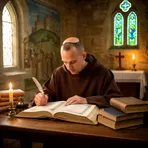
An English monk who wrote important books about English history and religion

An English monk and writer of important books about early English history and the Christian faith
Surface Forms
Morphology
the + venerable + Bede
The phrase is strictly compositional: the adjective 'venerable' (deserving respect for age or character) modifies the proper name 'Bede', so a learner who knows both words can infer it refers to an esteemed/respected person named Bede. This is not idiomatic or metaphorical but a descriptive honorific/title construction common across languages, so the meaning is directly derivable from the parts.
Etymology
The name the Venerable Bede comes from the title venerable, which means 'respected', and from Bede, the monk who wrote early English history. Picture an old monk in a quiet room writing books and people calling him 'venerable' because they trusted his knowledge, so the name shows he was a respected teacher and historian.

