
tetrapod
 3
7.9

- noun
- /ˈtɛtrəˌpɒd/
- Specialized
- The ancient fossils revealed that the first tetrapods emerged from the water to explore life on land.
- early tetrapods
- Devonian tetrapods
- tetrapod vertebrates
Loading YouTube…
Watch on YouTubeAnd only the tetrapod fish managed to get out.
- And only the tetrapod fish managed to get out.
Examples
-
With greater speed and range of movement, tetrapods could breathe more easily and eat a greater variety of substances.
Academic text (2003) -
The first tetrapods probably forced air in and out of their lungs by a process called buccal pumping.
Academic text (2003) -
And only the tetrapod fish managed to get out.
-
Trackways have now confirmed the presence of early tetrapods in Ireland and even in Australia.
Academic text (2006) -
Their presence suggests that tetrapods originated in that region, perhaps just a short time later, geologically speaking.
Academic text (2006) -
The Red Hill tetrapods lived in a river basin surrounded by diverse flora and fauna.
Academic text (2006) -
Ichthyostega was the oldest known tetrapod—an animal having four legs with toes.
Academic text (2006) -
Scientists believe that early tetrapods evolved limbs that allowed them to move more effectively on land.
-
Amphibians and reptiles are both classified as tetrapods, showcasing the diverse adaptations of four-limbed animals.
Surface Forms
Morphology
tetrapod = pod (semi-transparent) = tetra + pod
The components 'tetra-' (four) and '-pod' (foot) are transparent in scientific formation, but their Greek origin and technical usage make the relation only partly obvious to general learners.
Etymology
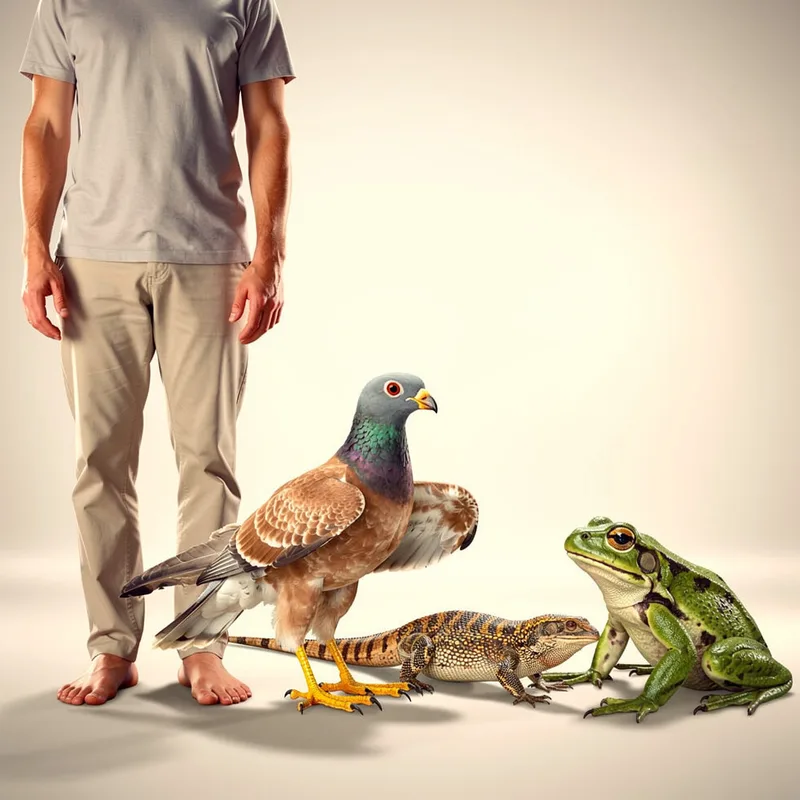
Tetrapod comes from the Greek parts tetra- 'four' and -pod 'foot', so it literally means 'four-foot'. That's why tetrapod is used for animals like frogs, lizards, birds, and humans that have four legs or leg-like parts.