

temporal gyrus
- noun
- /ˈtɛmpərəl ˈɡaɪrəs/
- Specialized
- While viewing positive images, women showed stronger and more extensive activation in the right superior temporal gyrus, which is involved in auditory processing and memory.
- superior temporal gyrus
Examples
-
When listening to melodies, research shows bilateral activation of the BA 22, also known as the superior temporal gyrus.
Academic text (2015) -
So what you see here is the superior temporal gyrus here Gray matter white matter.
-
Instead, the strongest signal disparities occurred in the subjects' LH, the left inferior frontal and temporal gyri, or cortical folds, in particular.
Academic text (2008) -
With respect to metaphors only, controls clearly reacted more strongly than patients in the RH (more specifically, the right precuneus and right middle/superior temporal gyrus).
Academic text (2008) -
First, all three types of statements stimulated the classical language areas of the LH: moving roughly from front to back, the left inferior frontal gyrus, the left inferior temporal gyrus, and the left inferior extrastriate region.
Academic text (2008) -
The superior temporal gyrus plays a crucial role in processing auditory information.
-
Researchers found increased activity in the right temporal gyrus while subjects listened to music.
-
Damage to the left temporal gyrus can affect language comprehension and memory.
Synonyms

 2
9.9
2
9.9

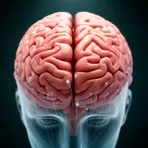
A raised fold on the brain surface between two grooves
 1
8.6
1
8.6
A fold on the brain surface that increases its outer area
Surface Forms
Morphology
The term directly combines 'temporal' (relating to the temple/temporal lobe) with 'gyrus' (an outward fold on the brain), so the meaning 'a convolution in the temporal lobe' is straightforwardly derivable from the parts. Although it is technical vocabulary, the adjective+noun composition is compositional and mirrors equivalents in other languages, making it understandable to a learner who knows both constituents.
Etymology
Temporal gyrus comes from two parts: temporal (from a word for the 'side of the head' or temple) and gyrus (an old word for a 'fold' or ridge). So the name literally means a folded ridge at the side of the head, which fits why this brain area helps with hearing, language and memory.