
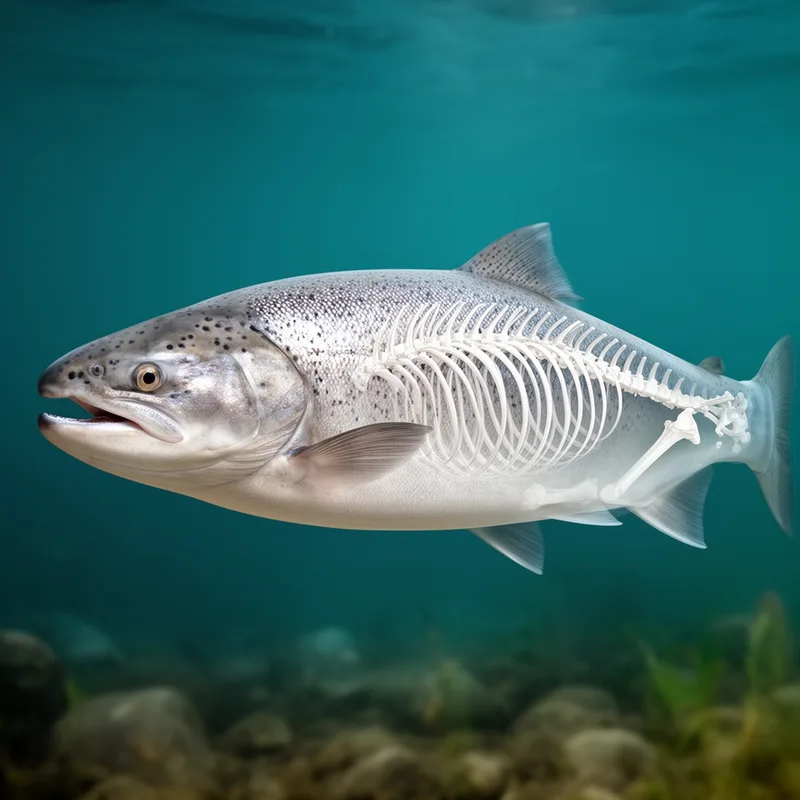
teleost


 1
9.9
1
9.9
- noun
- /ˈtɛliˌɑst/
- Specialized
- The teleost fish swims gracefully through the coral reef, showcasing its vibrant colors.
- teleost fish
Examples
-
This group of fishes includes more than 4,064 genera and 24,000 species, with several thousand more teleost species yet to be discovered and described (Helfman et al. 1997, Nelson 2006).
Academic text (2010) -
Except for A. nigropunctatus, caught only in 1991, all resident teleost species are found in the record of Gulf fishes.
Academic text (1995) -
Only model fishes and several important taxa in aquaculture, fisheries, and the aquarium trade are selected as teleost representatives in the tree.
Academic text (2010) -
The minimum number of ingested teleosts was estimated as a function of the total number of saggita otoliths of the most representative side (left or right) for each species in each stomach.
Academic text (2018) -
The teleost radiation, consisting of the most apical or "advanced" ray-finned fishes and responsible for much of the established ichthyofauna seen today, is one of the most remarkable species diversification events in the history of Earth.
Academic text (2010) -
The phylogeny also indicated that the pair of glucagon receptor genes is the product of a gene duplication event that occurred before the divergence of the teleost fish, consistent with its being part of a genome duplication event (Figure 3).
Academic text (2006) -
Researchers discovered a new species of teleost that thrives in the deep ocean.
-
Unlike other fish, teleosts have a unique structure in their skeleton, making them highly adaptable.
Synonyms
 1
7.4
1
7.4
A bony fish with a jaw that can move and a symmetrical tail, like salmon or goldfish
 1
3.7
1
3.7
A fish with a skeleton made mainly of bone, like a salmon or goldfish
A fish with bones like a trout or goldfish that has a movable jaw

A large group of fish with bones that includes most living fish

A group of fish with skeletons made mostly of bone
Compounds
- Specialized
1
7.4
A bony fish with a jaw that can move and a symmetrical tail, like salmon or goldfish
Surface Forms
Morphology
teleost = teleo + ost
A technical biological term formed from specialized Greek combining forms (not productive or familiar to average learners), so the components do not help learners infer the meaning.
Etymology
Teleost comes from the Greek parts teleos 'complete' and osteon 'bone', so it literally means 'complete bone' and gives the image of a fish with a full, hard skeleton. That's why most modern bony fishes, like trout and salmon, are called teleosts.