

tea ceremony
 3
5.3
3
5.3

- noun
- /tiː ˈsɛrɪˌmoʊni/
- Formal
- During the tea ceremony, guests sat quietly and appreciated the delicate flavors of the freshly brewed tea.
- Japanese tea ceremony
- tea ceremony and flower arrangement
Loading YouTube…
Watch on YouTubeAnd it expresses the idea of the tea ceremony where you know your tea master serves tea to small number of guests.
- And it expresses the idea of the tea ceremony where you know your tea master serves tea to small number of guests.
- He's an expert in tea ceremony and a practicing psychiatrist in the faculty at Stanford for many, many years.
Examples
-
After a 20-minute box lunch, we will take the harbor tour by boat, then the city tour by bus, and we will end the afternoon at 1700 with a genuine Japanese tea ceremony.
-
After dinner, Giles asked if we'd like to participate in a tea ceremony.
Fiction book (1996) -
And I love when they do the tea ceremony and you get the green tea which they mix right in front of you.
-
And I am stopping in Japan on the way back to the States, so I will have to participate in a traditional Japanese tea ceremony.
Blog text (29) -
Yes, we have a tea ceremony to attend, and if we don't hurry up, we'll be late.
-
Since the age of six, she had practiced the art of the tea ceremony and knew the intricacies of high breeding.
Fiction book (1996) -
A well-maintained rock garden or a well-performed tea ceremony, both Japanese cultural artifacts of Buddhist inspiration, perfectly express this sense of pervasive calm.
Blog text (7) -
Similar motivations underlay the teaching of traditional arts such as flower arrangement and tea ceremony to contemporary Japanese women (Rowland Mori 1996).
Academic text (1999) -
Giles had also spent months in Japan learning the tea ceremony and buying fabulously expensive cracked and mended pots and exquisitely crude Korean cups.
Fiction book (1996) -
The elegant tea ceremony included intricate rituals for preparing and serving the tea.
Synonyms
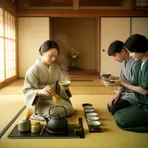
A Japanese ceremony for making and drinking tea with set rules
How Formal

Surface Forms
Morphology
The meaning is the straightforward combination of 'tea' (a drink) and 'ceremony' (a formal ritual), so a learner who knows both words can infer it refers to a formal ritual involving tea. This concept also exists cross-linguistically (e.g. Japanese, Chinese, Spanish), making the composition pattern obvious to B1 learners.
Etymology
The phrase tea ceremony comes from old Chinese and Japanese ways where making tea was done as a careful ceremony with slow, exact steps and quiet attention. So, the phrase now means 'a formal, careful way to prepare, serve, and drink tea'.