

taro
 4
6.5
4
6.5

- noun
- /ˈtɑːroʊ/
- Diets were primarily pig, seafood, and fish, fibrous vegetables, starches (taro, breadfruit, etc.), coconut, and fruit.
- taro patch
- taro root
- taro as a food staple
Loading YouTube…
Watch on YouTubeAnd also their relationship with kalo or Taro.
- And also their relationship with kalo or Taro.
- To me, Taro boba tastes like buttered popcorn, Jelly bellies.
- They love tubers like yams, like picama, like Taro root, like yuca or yuca.
Examples
-
Moana and Tapairo pour thick coconut milk and fish soup into him, alternating with mashed papaya and taro root.
Fiction book (1995) -
Kaohis have got themselves a nice little business: Along with taro, they grow organic produce and sell it to the fancier restaurants down at Poipu.
Fiction book (1999) -
Don't trip on the taro root
-
This is taro root!
-
Root crops grown in gardens include taro, yam, and sweet potato.
Academic text (1992) -
One participant brought a baggie of Oobleck he'd made using starch from taro, a food staple on Pohnpei.
Academic text (1995) -
Managalase are primarily subsistence horticulturalists who cultivate yams, taro, bananas, and sugar cane as their staples.
Academic text (1991) -
In one such week-long ceremony, the distribution included 160 pigs, 1,900 baskets of taro, and 60 bunches of bananas (ML B304: 44).
Academic text (1991) -
Many people enjoy eating taro fries as a delicious alternative to regular potatoes.
-
In Hawaii, taro is often used to make a traditional dish called poi, which is a staple food.
Synonyms
 1
9.4
1
9.4
A plant like taro with a starchy root eaten as food in Hawaii and used to make poi

A tropical plant with large shiny leaves and a starchy root used for food

A large root like a potato that people cook and eat in tropical countries
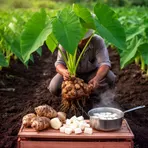
A tropical plant with big leaves whose root you can cook and eat

A tropical plant with a large root used as food

A tropical plant grown for its starchy edible root and large shiny leaves
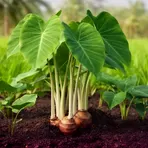
A group of tropical plants that includes the taro plant

A large tropical plant with very big leaves grown for its edible underground stem

A tropical plant that has a large starchy root people eat

A tropical plant with a starchy root that people eat as a vegetable
Compounds
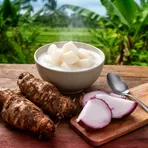
- Australian
A large tropical plant with very big leaves grown for its edible underground stem
Surface Forms
Etymology
Taro comes from Pacific island languages such as Polynesian and Tahitian, where people have grown the plant for its 'starchy' root for a long time. That's why taro today means the large-leaved plant and its edible 'starchy root' used as a staple food or in desserts.