

talipes equinus
- noun
- /ˈtælɪˌpiːz ˈɛkwɪnəs/
- Specialized
- Talipes equinus often affects walking because the heel cannot touch the ground.
Examples
-
The patient was diagnosed with talipes equinus at birth and required corrective surgery.
-
Physical therapy can help improve mobility in children with talipes equinus.
-
The child was diagnosed with talipes equinus at birth.
-
After the examination, the doctor confirmed it was talipes equinus.
-
Children with talipes equinus may need to wear special shoes to help correct their foot position.
-
Treatment for talipes equinus often involves exercises that strengthen the muscles in the lower leg.
-
The doctor explained that talipes equinus could cause difficulty in walking if not treated early.
Synonyms


 1
9.9
1
9.9
A foot that is twisted at birth and points down or inward

A foot fixed pointing down so the heel does not touch the ground

A foot condition where the toes point up and someone walks on the heel
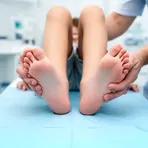
A foot turned outward so the sole faces away from the center of the body
Surface Forms
Morphology
The compound is a compositional medical term: 'talipes' denotes a twisted/abnormal foot position and 'equinus' denotes a plantarflexed (downward-pointing) foot. If a learner knows these constituent meanings, the combined sense — a form of clubfoot with toes pointing downward — is directly derivable, and the Latin-based medical formation is commonly transparent across languages in medical contexts.
Etymology
Talipes equinus comes from Latin parts talus meaning 'ankle', pes meaning 'foot', and equinus meaning 'horse'. Because the foot looks like a horse's hoof with the toes pointing down, the name is used for a condition where the 'toes point down'.