
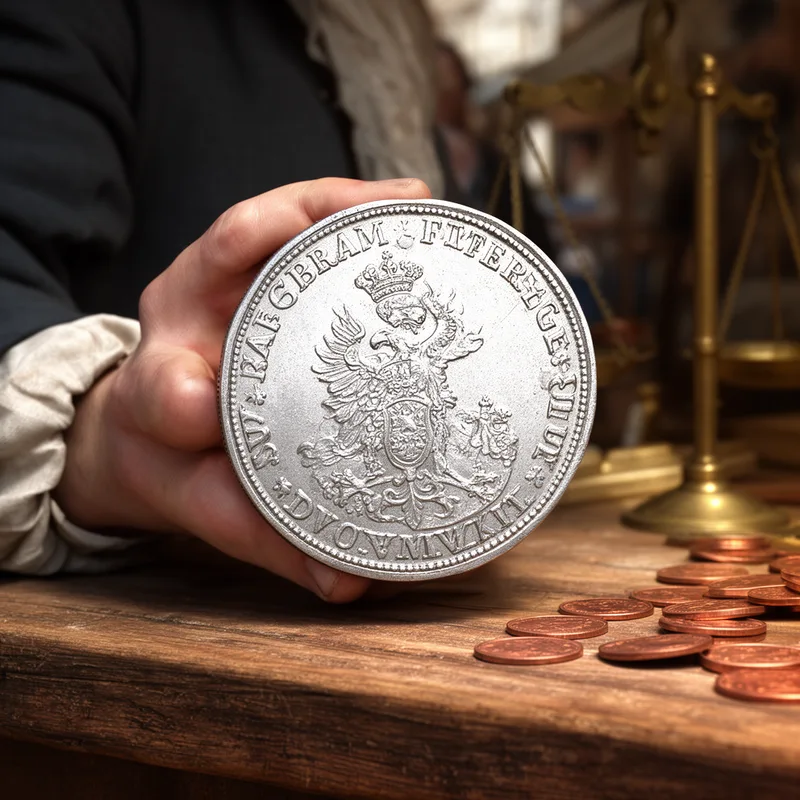
taler
- noun
- /ˈtɑːlər/
- Archaic
- The enemy takes a fisherman's son captive and gives the fisherman 600 talers for him, whereupon the fisherman gives this money to the lords of the city for the ransom and becomes mayor.
Examples
-
After introducing the setting and the siege in the first line, the narrator explains that whoever could obtain the 600 talers that the enemy demanded would become mayor of the city.
Academic text (2016) -
As a result, Schinkel could not meet the 700,000 taler budget stipulated by the king in 1822.
Academic text (1990) -
Half in gold, half in talers will do
-
- Must be one of them immersive talers.
-
In 1548, the German city of Luneburg issued a particularly interesting coin, a silver taler weighing 28 grams (see figure 9).
Academic text (1995) -
He paid for the ornate book with a silver taler that was minted over three centuries ago.
-
The treasure chest was filled with gold coins and several ancient talers from the 17th century.
-
In the museum, we saw a display of historical talers that were used as currency in Europe.
Synonyms
A large silver coin used in Europe long ago
Surface Forms
Etymology
Taler comes from the old name Joachimsthaler, a coin first made in Joachim's Valley in Central Europe. The part thal means 'valley', so Joachimsthaler meant 'from Joachim's valley'. The name was shortened to taler to mean a large silver coin, and it later became the English word dollar.

