
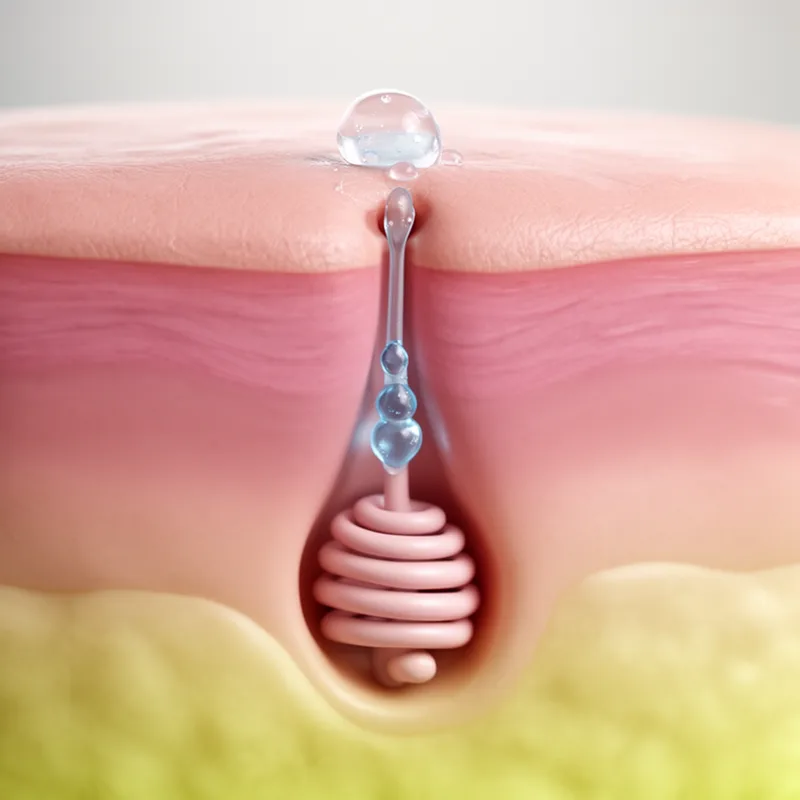
sweat duct


 1
3.7
1
3.7
- noun
- /swɛt dʌkt/
- Specialized
 :
conducto sudoríparo
:
conducto sudoríparo
- Blocked sweat ducts can lead to skin irritation and increase the risk of heat rash.
Examples
-
When you exercise, your sweat ducts become active and release moisture to the surface of your skin.
-
Ultrafine particles of clay then enter the skin of the feet via the sweat ducts or through microtrauma, perhaps aggravated by the abrasive effect of quartz crystals.
Academic text (1994) -
The dermatologist explained how sweat can travel through the sweat duct to help cool the body down.
Synonyms
 145
4.1
145
4.1
A tube that carries a liquid or gas from one place to another
 1
8.3
1
8.3
A tube in the body that carries fluids like blood or bile

A tiny tube that carries fluid in the body

A very small tube in the body that carries fluids like bile or tears
Surface Forms
Morphology
The meaning is directly and compositionally derived from 'sweat' (the fluid) + 'duct' (a channel), yielding a channel that carries sweat to the skin surface. This noun–noun compounding follows transparent, cross-linguistic anatomical naming patterns, so a B1 learner who knows both constituents should understand the term.
Etymology
Sweat duct gives a clear, physical picture: the word sweat plus duct (an old word for a small tube) makes you imagine a tiny straw that carries sweat from a gland to the skin. So, it means 'a small tube in the skin that carries sweat to the skin's surface'.