
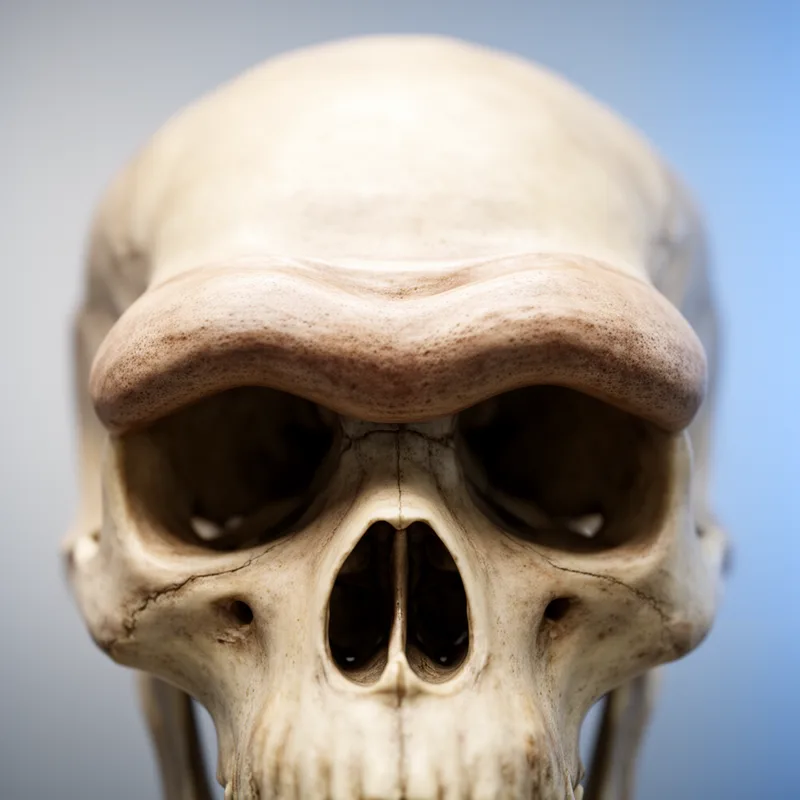
supraorbital torus
- noun
- /ˌsuːprəˈɔːrbɪtəl ˈtɔːrəs/
- Specialized
- The fossil skull featured a pronounced supraorbital torus characteristic of early Homo species.
Examples
-
Some modern human populations retain a modest supraorbital torus above the eyes.
-
Researchers measured the thickness of the supraorbital torus to compare evolutionary traits.
-
The supraorbital torus is a key feature in identifying early hominids.
-
Many anthropologists study the supraorbital tori of ancient skulls.
-
The fossil skull featured a pronounced supraorbital torus characteristic of early Homo species.
-
Researchers measured the thickness of the supraorbital torus to compare evolutionary traits.
-
Some modern human populations retain a modest supraorbital torus above the eyes.
Synonyms

 1
9.9
1
9.9

A raised bone above the eye socket on the forehead

 1
9.9
1
9.9
A raised line of bone above the eye socket that forms the brow

A ridge of bone above the eye socket on the forehead
How Prominent

Surface Forms
Morphology
The element 'supraorbital' clearly signals location above the eye socket, so the locative component is transparent. However, 'torus' is a technical term whose everyday/geometric sense (a rotated circle) does not transparently map to 'a bony ridge' without anatomical knowledge, so the overall meaning is only partially predictable to a B1 learner.
Etymology
Supraorbital torus is a name that literally shows a bony 'ridge' 'above' the 'eye sockets'. The parts supra ('above'), orbital ('eye socket') and torus ('ridge') give the image of a thick brow shelf, so the term refers to the strong ridge seen on some early human skulls and in a few people today.