

stratum corneum
- noun
- /ˈstreɪtəm ˈkɔrnɪəm/
- Specialized
- The moisturizing cream has a smaller molecular volume than the emulsions, able to penetrate into the stratum corneum and moisturize dry cells.
Examples
-
The cells at the basement membrane increase in size, density, and speed of transport across the epidermis, increasing the thickness of the stratum corneum layer.
Academic text (1995) -
With a greater volume of stratum corneum, shear stress gradients are lower; thus, the skin is at lower risk of failure.
Academic text (1995) -
The rate of migration of cells from the basement membrane to the stratum corneum was two to three times higher than in the control (59).
Academic text (1995) -
The thickened stratum corneum means that there is a greater volume through which to distribute the shear load between the skin surface and immediately above the basement membrane.
Academic text (1995) -
There is increased expression of cytokines in the skin in which the barrier function of the stratum corneum is impaired, but it remains to be seen if this finding can be extended to older people with pruritus.
Academic text (1999) -
Friction blisters generally occur only on the palms and soles where the overlying stratum corneum is thick enough to form a roof on the blister.
Academic text (1995) -
In response to repeated rubbing, the skin becomes red, there is slight flaking of the stratum corneum, and finally the epidermis ruptures suddenly, producing sharp pain and a crater in the skin.
Academic text (1995) -
The stratum corneum serves as a protective barrier for our skin, helping to prevent moisture loss.
-
A healthy stratum corneum is essential for maintaining skin hydration and overall health.
-
Products designed to improve the stratum corneum can enhance skin's texture and appearance.
Synonyms
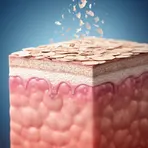
The outer layer of skin made of dead flat cells that fall off regularly

The outer layer of skin made of dead cells that fall off
Surface Forms
Morphology
The term is directly compositional: 'stratum' means a layer and 'corneum' refers to the horny/outer layer of skin, so the combined meaning (the outermost layer of the epidermis) follows from the constituents. Although the phrase is a technical, Latin-derived medical term, a learner who knows both constituent meanings can immediately infer the MWE meaning.
Etymology
Stratum corneum comes from Latin words stratum meaning 'layer' and corneum meaning 'horn-like'. It is the top, hard layer of skin made of dead cells that protect the body, so the name helps you remember it is the outer protective layer.

