
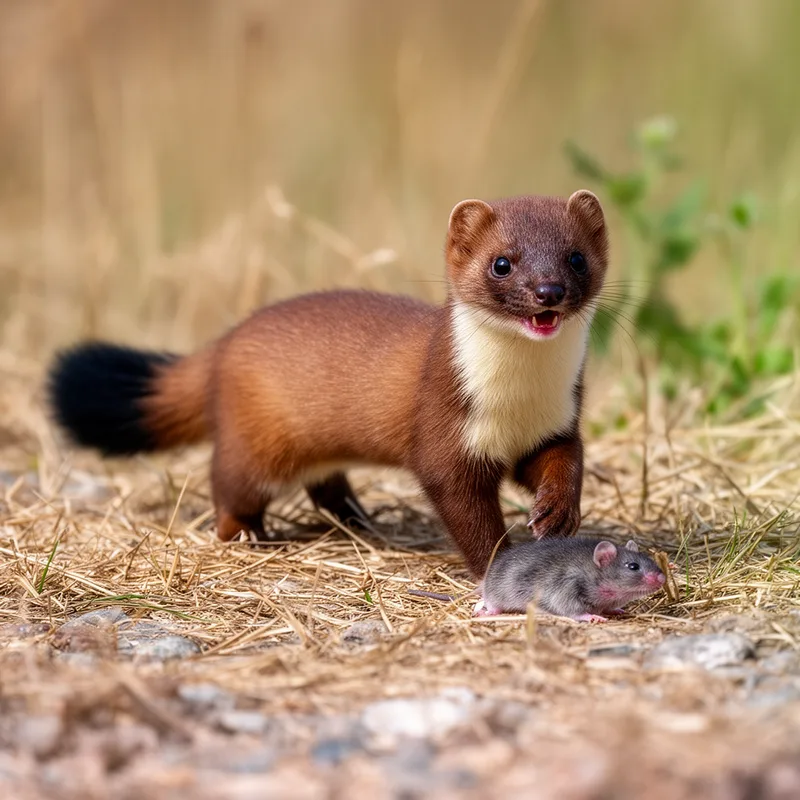
stoat
 2
8.8
2
8.8

- noun
- /stoʊt/
 :
comadreja
:
comadreja
- The stoat is known for its slender body and agility in chasing small prey.
He extended a yellow Gray finger, pointing directly at Pantalamion, whose red brown stoat form immediately became Irmine Irmine White.
- He extended a yellow Gray finger, pointing directly at Pantalamion, whose red brown stoat form immediately became Irmine Irmine White.
Examples
-
If prey size dictates weasel size, then New Zealand stoats should be larger than those in Europe.
Academic text (1991) -
Black cat and a stoat, sir.
-
No stoat in here, is there?
-
The stoat has dark brown fur in the summer and white fur in the winter.
Blog text (7) -
In fact, the stoats are becoming larger, even though they have lived in New Zealand for only about a century.
Academic text (1991) -
And there's a rat called Rupert and a stoat who goes by the name of Howard.
-
There was the pika and the platypus, the zebu and the stoat.
Fiction book (2002) -
The stoats thrived on the rabbits, but since New Zealand has no voles, the common weasels became (and remain) scarce.
Academic text (1991) -
After studying the diets of European stoats, zoologist Sam Erlinge concluded that regional variation in the size of stoats is directly related to the size of the prey available.
Academic text (1991) -
During the wildlife tour, we spotted a stoat darting through the underbrush.
Synonyms
A small animal like a weasel that turns white in winter except for its black tail tip

A small mammal that eats meat and turns white in winter
Surface Forms
Etymology
The word stoat comes from an old German word for a small, quick animal and names the little carnivore related to the weasel. A helpful way to remember it is that a stoat often 'turns white' in winter and is also called an ermine, so the name fits a small, fast mammal with a changing coat.