
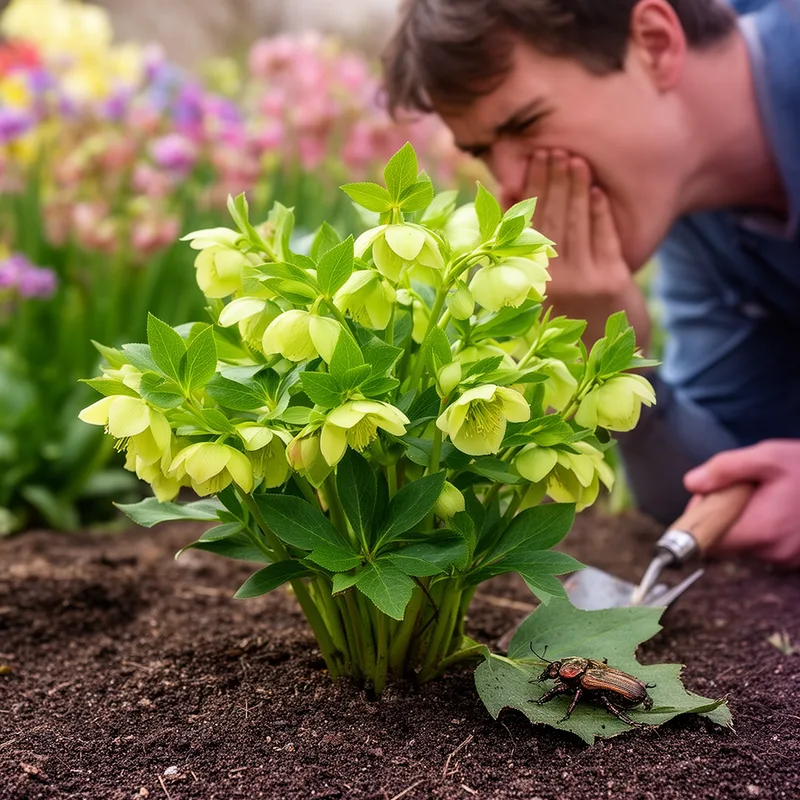
stinking hellebore
- noun
- /ˈstɪŋkɪŋ ˈhɛlɪbɔr/
- Specialized
- Gardeners are often warned not to ingest stinking hellebore because of its toxic properties.
Examples
-
Despite its attractive appearance, the stinking hellebore gives off a strong, unpleasant odor.
-
The stinking hellebore produces clusters of pale green flowers early in spring.
-
The stinking hellebore is often found in damp woodlands.
-
Many gardeners avoid planting stinking hellebores due to their toxicity.
-
Despite its attractive appearance, the stinking hellebore gives off a strong, unpleasant odor.
-
Gardeners are often warned not to ingest stinking hellebore because of its toxic properties.
-
The stinking hellebore produces clusters of pale green flowers early in spring.
Synonyms
A garden plant with split leaves and a bad smell that can irritate if eaten

A plant with finger-like leaves and a bad smell that can make you sick if eaten

A plant with finger-like leaves that smells bad and can make you sick if eaten
Surface Forms
Morphology
The phrase is a literal adjectival description: 'stinking' (emitting a foul odor) modifies 'hellebore' (a genus of toxic plants), so the meaning is directly derivable as a type of hellebore that smells bad. There is no idiomatic or metaphorical shift here, so a B1 learner who knows both constituents would be able to understand the MWE.
Etymology
Stinking hellebore comes from the plant itself: the flowers and leaves often 'smell bad', so stinking shows that strong odor. The word hellebore is the old name for this poisonous plant, so the full name warns people that it is smelly and can be dangerous if eaten.

