
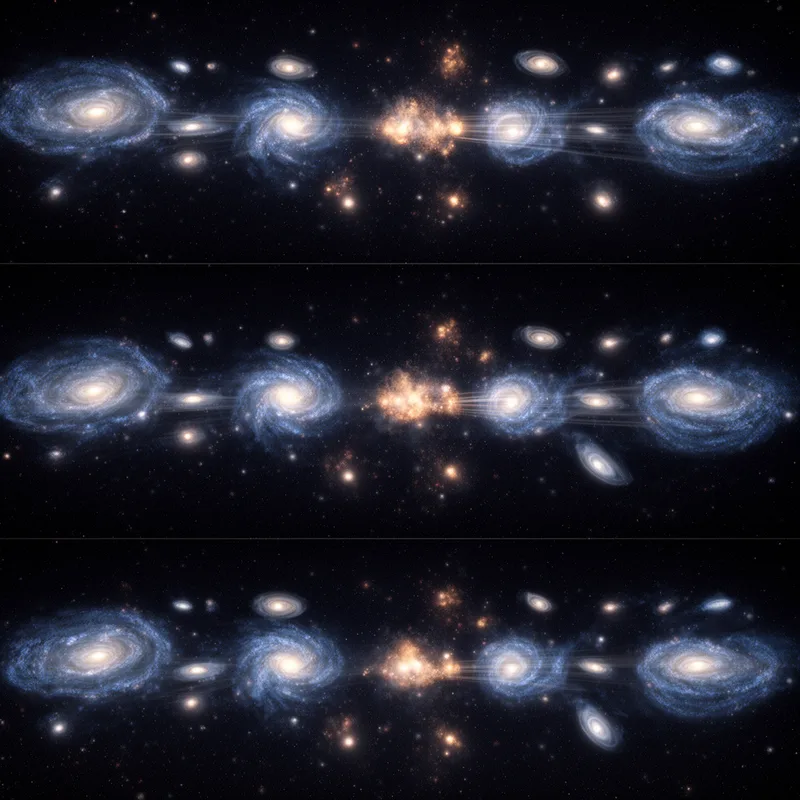
steady state theory
- noun
- /ˈstɛdi steɪt ˈθɪəri/
- Archaic
- According to the steady state theory, the universe maintains a constant average density over time.
Loading YouTube…
Watch on YouTubeWe're back really to why people like Hoyle said that the steady state theory is viable.
- We're back really to why people like Hoyle said that the steady state theory is viable.
Examples
-
The steady state theory required that the universe, though expanding, had always looked the same.
Academic text (2003) -
The steady-state theory provides no reasonable explanation for this radiation, but the big-bang model requires it.
Academic text (2002) -
We're back really to why people like Hoyle said that the steady state theory is viable.
-
Thus, the first direct observations of the CMB were nails in the coffin for the steady state theory.
Academic text (2003) -
Hoyle pioneered the steady-state theory.
Academic text (2006) -
Although almost all scientists now believe the steady-state theory to be incorrect, this alternative hypothesis served science well because it forced cosmologists to critically question their assumptions and conclusions.
Academic text (2002) -
Despite its aesthetic appeal to some astronomers, the steady-state theory gradually lost support as observational evidence showed that the universe does indeed change with time, as one would expect from a big bang universe.
Academic text (2002) -
The steady state theory suggests that the universe has no beginning or end, constantly creating new matter as it expands.
-
Scientists debate the validity of the steady state theory in light of new astronomical discoveries.
Synonyms

An idea that new matter is created so the universe keeps the same density as it expands
Antonyms
- Specialized
 4
4.1
4
4.1

An idea that the universe began when a hot, very dense point expanded quickly
Surface Forms
Morphology
The phrase is compositionally transparent at the level of its parts: a B1 learner who knows 'steady' (constant), 'state' (condition), and 'theory' (set of ideas) can infer it denotes a theory that posits a constant state. However, the full, technical cosmological implications (continuous creation of matter, no beginning or end) are specialized and not fully predictable from the constituents, so the expression is only partially transparent.
Etymology
Steady state theory comes from the simple idea that the universe stays in the same steady 'state': as galaxies move apart, new matter is created so the universe looks unchanged, like a room where people leave and new people arrive so the number stays the same. That's why the name means a model with 'no beginning or end'.