
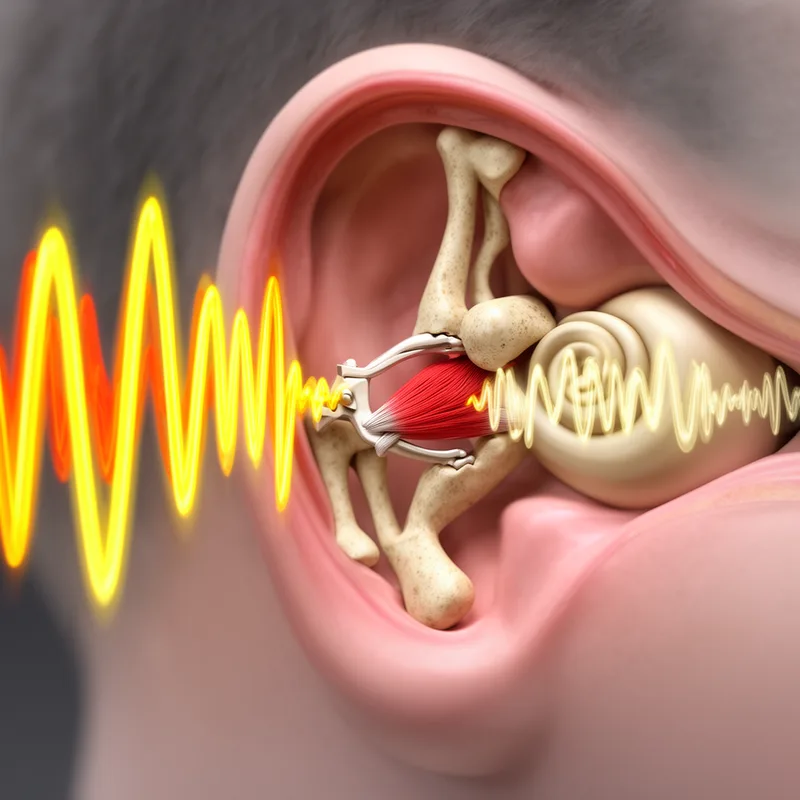
stapedius


 1
9.9
- noun
- /ˌstæpɪˈdiəs/
- Specialized
- Surgeons often examine the stapedius muscle during middle ear surgeries for proper functioning.
- stapedius muscle
- stapedius reflex
- stapedius muscle contraction
Examples
-
During surgery for otosclerosis, it is common for the surgeon to cut the stapedius tendon.
Academic text (1998) -
We measure the success of stapedius tendon reconstruction with impedance audiometry.
Academic text (1998) -
By then, the branch to the stapedius muscle is visible.
Academic text (2003) -
In contrast, in humans it appears that only the stapedius muscle contracts in response to acoustic stimuli.
Academic text (1998) -
Colletti found that patients heard better in noise when the stapedius tendon was preserved.
Academic text (1999) -
We believe our results validate the reconstruction of the stapedius tendon where possible.
Academic text (1998) -
Minimal contractions of the stapedius muscle and tendon occur in a person listening with great concentration.
Academic text (1998) -
Because of this arrangement, when the stapedius muscle contracts, the footplate is immediately fixed in the oval fossa.
Academic text (1998) -
Contraction of the stapedius muscle leads to an increase in the rigidity of the ossicular chain.
Academic text (1998) -
The stapedius muscle plays a vital role in controlling sound vibrations in the ear.
Surface Forms
Morphology
Etymology
Stapedius comes from the Latin word stapes, meaning 'stirrup', because the tiny bone it moves looks like a stirrup. So the stapedius is the small muscle that steadies that 'stirrup' bone and helps protect the ear from loud sounds.