

stamp duty


 1
4.8
1
4.8
- noun
- /stæmp ˈdjuːti/
- UK
- The government increased the stamp duty to help fund public services.
Loading YouTube…
Watch on YouTubeLike you have to pay tax, but you have to pay stamp duty.
- Like you have to pay tax, but you have to pay stamp duty.
- A really good example was the stamp duty change.
- But the, the, the I really begrudge the stamp duty.
Examples
-
Take a look at Sweden's experience with the Tobin tax or the UK's Stamp Duty.
Blog text (4) -
But more relevantly, the chancellor announcing the stamp duty holiday which is due to end at the end of March.
-
A Buyer's Stamp Duty was also implemented on residential purchases, imposing a 15% tax on buyers who are not Hong Kong permanent residents.
Blog text (19) -
"At the end of the deal, every flat is registered on the carpet area, the stamp duty and registration fees are paid on the carpet area, and thus the homebuyer automatically becomes aware of the carpet area," he said.
Blog text (4) -
When buying a house, you must pay a stamp duty to complete the legal process.
-
If you live in England and purchase property, you will have to calculate the stamp duty based on the home's price.
Synonyms
 1
7.2
1
7.2
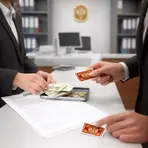
A payment you make by buying an official stamp and putting it on certain documents
How High

Surface Forms
Morphology
The meaning 'a tax paid by purchasing/affixing a stamp to certain documents' follows directly from combining 'stamp' (the adhesive paper) with 'duty' (a tax); the notion that a duty related to a stamp is literally signalled by the two words makes the sense compositional. This construction is also cross-linguistically common (e.g., French 'timbre fiscal', Spanish 'impuesto de timbre'), so a B1 learner who knows both constituents can reasonably infer the MWE's meaning.
Etymology
The noun stamp duty comes from an old way of paying a tax: people bought a paper stamp and stuck it on legal papers, and the word duty meant 'tax'. That's why stamp duty today means 'a tax on certain documents'.