
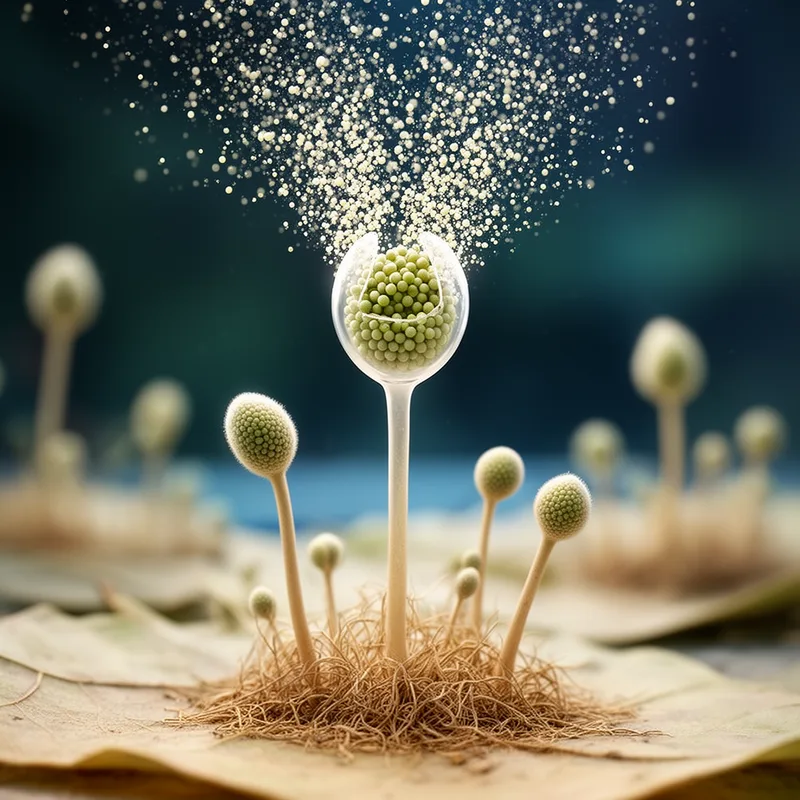
sporulation
- noun
- /ˌspɔːrjʊˈleɪʃən/
- Specialized
- In order to identify other species of AM fungi in the field, we "trapped" the fungi in pots, thereby promoting growth and inducing sporulation in a variety of, as yet, unseen species.
- growth and sporulation
Examples
-
Other factors: Arbuscular mycorrhizal fungi at our field site also appear to differ in life history characters, including duration of dormancy, germination requirements, and sporulation requirements.
Academic text (2001) -
According to DeVries and Toenniessen, "outbreaks of important pests and diseases of maize are related to complex egg-laying and sporulation responses, which are in turn dependent upon difficult-to-predict responses, global environmental factors, and human activity."
Academic text (2008) -
There are undoubtedly additional fungal species present at the site for which we have not yet adequately met growth and sporulation requirements.
Academic text (2001) -
The distinct conditions favorable to successful growth and sporulation reflect differences in AM fungal ecologies.
Academic text (2001) -
Once sporulation begins, the crop represents a new source from which urediniospores can initiate long-distance aerial dispersal.
Academic text (2005) -
The cultures were incubated at 34°C and periodically examined microscopically to detect sporulation.
Academic text (2003) -
The process of sporulation allows fungi to reproduce and spread their spores efficiently in the environment.
-
During sporulation, the plant releases spores into the air, which can lead to new growth in different locations.
-
Several factors, such as temperature and humidity, influence the timing of sporulation in various bacterial species.
Synonyms

A way of making new living things without sex by producing and releasing spores
Surface Forms
Morphology
Etymology
The word sporulation comes from spore, which comes from the Greek spora meaning 'seed' or 'sowing'. So sporulation is the process of making 'seeds' called spores to spread and survive.

