
spirometric


 1
6.9
- adjective
- /ˌspaɪrəˈmɛtrɪk/
- Specialized
- Some of the spirometric findings could be related to smoking history.
- spirometric findings
Examples
-
Forced expiratory volume in 1 s (FEV1) and forced vital capacity (FVC) were recorded by a standard spirometric method.
Academic text (2001) -
'Pocket' spirometry can be a helpful case-finding tool to identify those symptomatic individuals who need full spirometric assessment.
Academic text (2014) -
Spirometric findings were also very low.
Academic text (1996) -
We also analyzed spirometric changes in both groups and compared them.
Academic text (2007) -
Spirometric measures on arrival and after treatment are presented in Tables 2 and 3.
Academic text (2007) -
However, there was no excess frequency of abnormal spirometric findings.
Academic text (1996) -
Some 80% of these patients had spirometric findings suggestive of extrathoracic upper airway obstruction.
Academic text (2009) -
Spirometric variable and percentage of change to baseline FVC, FEV1, and FEF 25-75% after treatment were calculated.
Academic text (2007) -
Any documented clinical worsening (e.g., the presence of upper respiratory tract infection or a decrease in spirometric values) necessitated that the procedure be rescheduled.
Academic text (2003) -
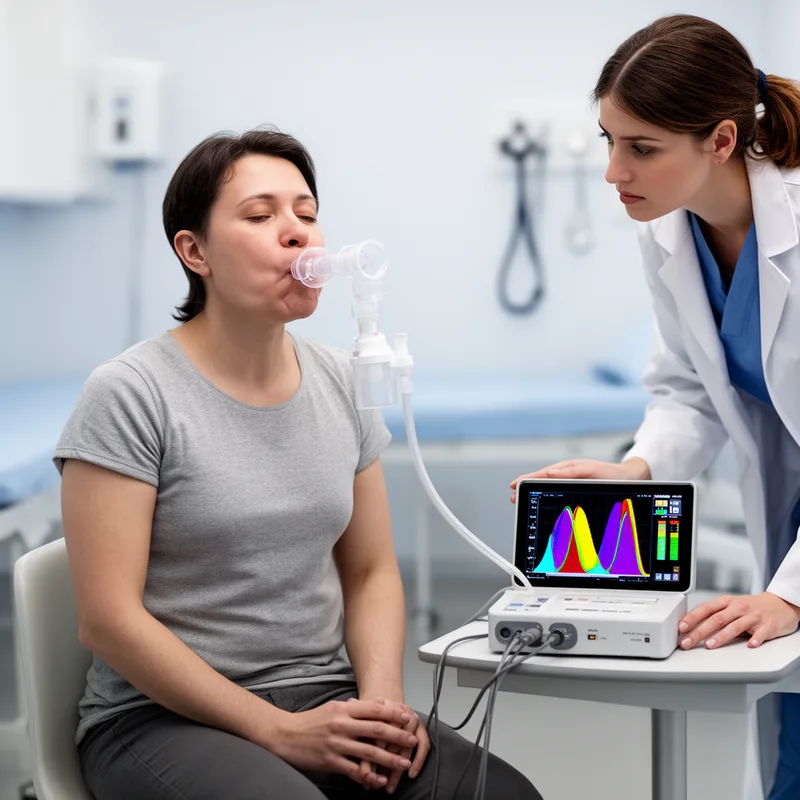
The doctor explained that spirometric tests can help diagnose lung diseases.
Surface Forms
Morphology
spirometric = spirometer (transparent) = spiro + meter + ic
The adjective is formed regularly from 'spirometer' with the suffix -ic, so its meaning is directly recoverable.
Etymology
The word spirometric comes from spiro- meaning 'to breathe', as in inspire and respire, and -metric meaning 'measure', like meter. So it means 'measuring breath', which is why it refers to tests that check how well the lungs work.