
spicule


 1
9.9
- noun
- /ˈspɪkjul/
- Specialized
- You have some narrowing of the space, arthritic spicules, in there, and it's not gonna function very well.
- bony spicules
- bone spicules
Examples
-
Like the soft corals, the sponges have flexible internal skeletons made of interlocking pieces called spicules.
Academic text (1992) -
The surface of the filaments is covered by a blanket of tiny spicules, or small skeletal projections.
Academic text (1995) -
This is now a single dendrite, one of those spicules sticking out from the cell body, from one of the branches of it.
-
Sponges typically have sharp microscopic structures known as spicules in their body, which can get embedded into one's skin.
Blog text (8) -
So here we see, for example, a sponge spicule, two bits of coral here, that's a sea urchin spine, really some amazing stuff.
-
Sponges are supported by a network of small, sharp structures called spicules that help maintain their shape.
-
Marine organisms such as corals and sponges use spicules as part of their internal skeleton to provide structure and protection.
-
The spicules found in some freshwater invertebrates can vary in shape and size, contributing to their unique skeletal systems.
Synonyms

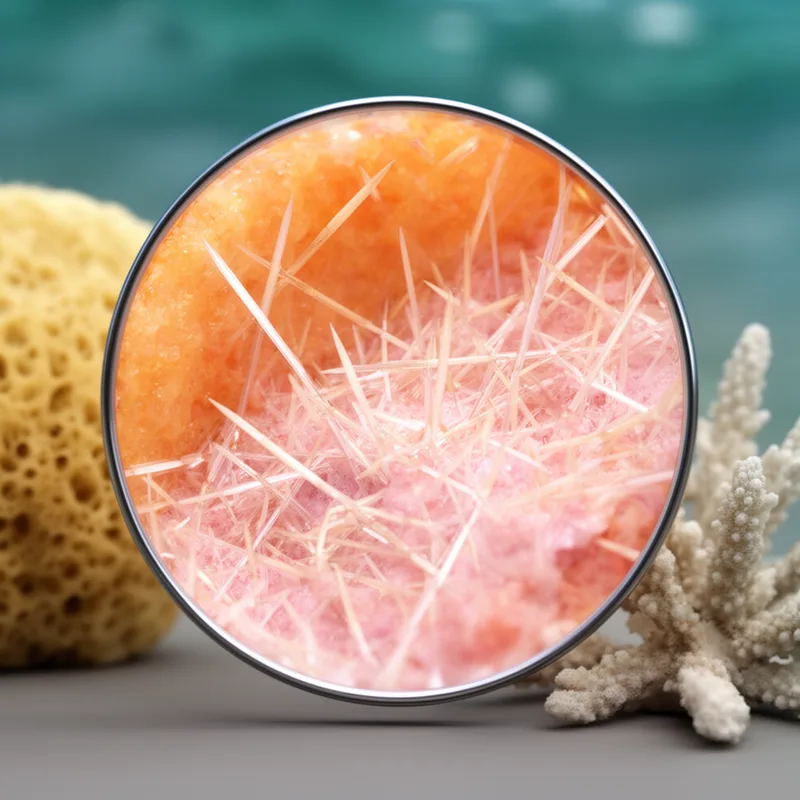
A tiny pointed piece in animals like sponges or corals that supports their skeleton
Surface Forms
Morphology
spicule = spicul + ule
Formed from a Latin combining root plus the diminutive suffix '-ule'; these parts are not productive or familiar to an average B1 learner, so the meaning is not predictably derived from the components.
Etymology
Spicule comes from the Latin spiculum, which means 'small spear', and it is like the English word spike; a helpful image is a tiny 'spear' or 'needle' inside a sponge or coral, which explains why spicules are the small, pointed parts of their skeleton.