
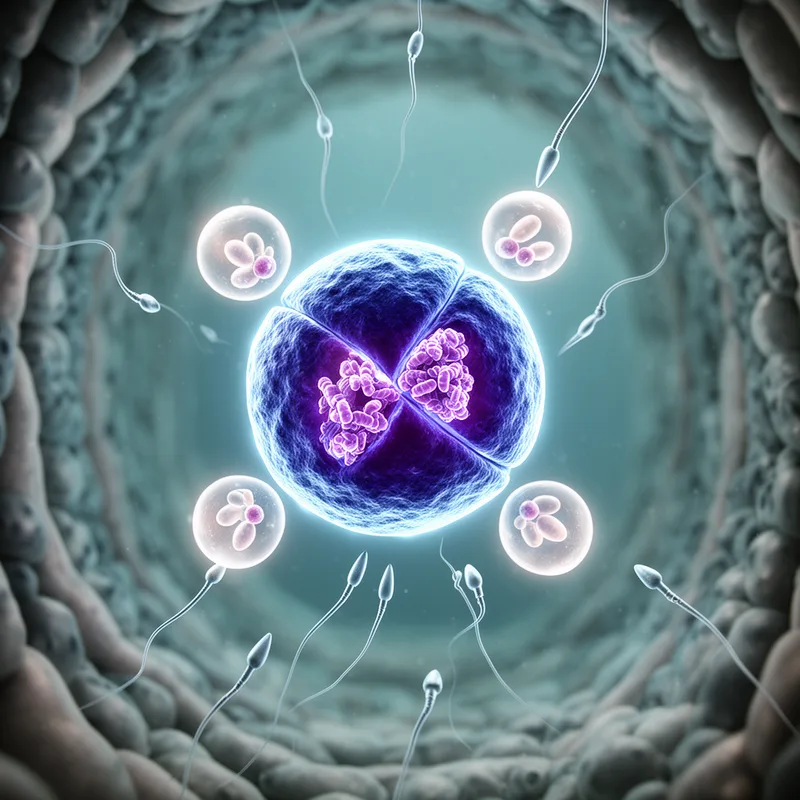
spermatocyte
- noun
- /ˈspɜr.mə.təˌsaɪt/
- Specialized
- The most mature spermatogenic cell type present is the early spermatocyte, indicating an early meiotic arrest of spermatogenesis.
Loading YouTube…
Watch on YouTubeSo there's not as much long distance migration of the spermatis of the spermatocytes and the sperm cells as there is the egg.
- So there's not as much long distance migration of the spermatis of the spermatocytes and the sperm cells as there is the egg.
Examples
-
A primary spermatocyte is responsible for the generation of haploid cells that become functional sperm after division.
-
Using micromanipulation, light microscopy, and immunofluorescence in grasshopper spermatocytes, these authors determined that the longer chromosomes remained off the spindle, the more strongly they stained.
Academic text (2009) -
Early spermatocytes were the most mature cell types present.
Academic text (2003) -
During spermatogenesis, each primary spermatocyte divides to produce four spermatids, which eventually develop into sperm.
-
The male reproductive system produces spermatocytes that undergo meiosis to form sperm cells.
How Mature
- Specialized


 1
9.6
1
9.6

- Specialized
- Specialized
- Specialized
Surface Forms
Morphology
Etymology
The word spermatocyte comes from the Greek parts sperma meaning 'seed' (like the English word sperm) and -cyte meaning 'cell'. So think of it as a 'seed cell', a cell in the male testes that divides to make sperm, which is why spermatocytes develop into spermatids and then sperm.