
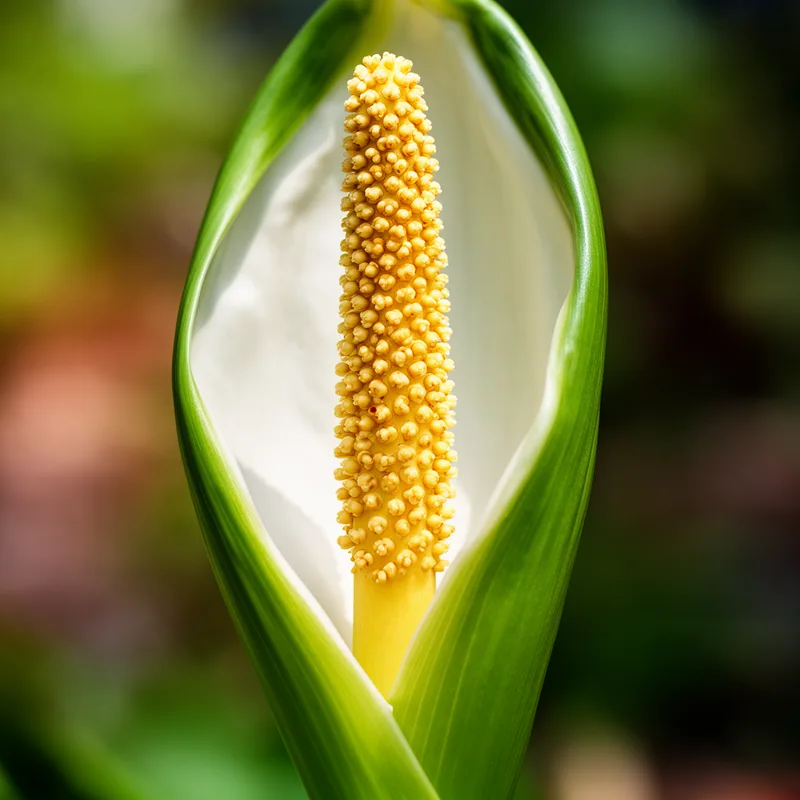
spadix


 1
9.9
- noun
- /ˈspeɪdɪks/
- Specialized
- Interestingly, the skunk cabbage spadix is able to generate intense heat through an unusual type of respiration; it is a plant exhibiting thermogenesis.
Examples
-
The difference between the spadix and the outside temperature may be 25°C (77°F) or more and can melt the surrounding snow—a warm oasis in the middle of coldness!
Academic text (2010) -
The spadix of the calla lily is surrounded by a large, green spathe that adds to its beauty.
-
It heats up and the Spadix, which is this big middle portion, it looks like a tower.
-
('Maria' is different in that its spathes tend to open wider and stand away from the spadix.)
Blog text (15) -
I don't know whether the spadix will survive without the spathe, or whether one dying means they're both doomed.
Blog text (15) -
Often, the flowers emerge, but the spathe remains so tightly wrapped around the spadix that it's not possible to remove or introduce pollen without destroying the flower.
Blog text (15) -
Unlike the florist's Anthurium, which has a heart-shaped red spathe and a white spadix at its center, monkeytail has a green spathe with a purple spadix.
Academic text (1995) -
Unlike the florist's Anthurium, which has a heart-shaped red spathe and a white spadix at its center, monkeytail has a green spathe with a purple spadix.
Academic text (1995) -
In some plants, the spadix can be quite tall and contains many tiny flowers tightly packed together.
-
The unique shape of the spadix makes it a fascinating feature of certain tropical plants.
Surface Forms
Etymology
Spadix comes from Latin, where the word was used for a kind of 'palm' or for a 'brown', palm-like spike. So in botany a spadix is the thick, fleshy spike that holds many small flowers, like the flower spike on a banana or a calla lily.