
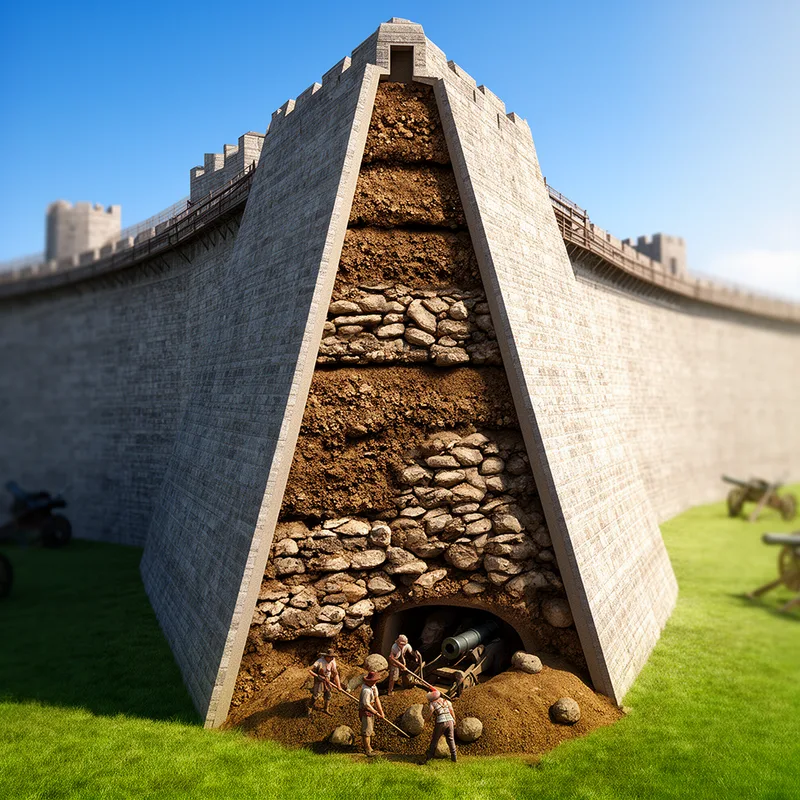
solid bastion
- noun
- /ˈsɑːlɪd ˈbæstʃən/
- Unlike a hollow bastion, a solid bastion offers greater durability since there are no empty spaces inside.
Examples
-
The engineers recommended constructing a solid bastion to withstand potential siege artillery.
-
The castle's defenses included a solid bastion on its northern wall, providing significant strength against attacks.
-
A solid bastion stands firm.
-
The solid bastion was impressive!
-
The castle's defenses included a solid bastion on its northern wall, providing significant strength against attacks.
-
The engineers recommended constructing a solid bastion to withstand potential siege artillery.
-
Unlike a hollow bastion, a solid bastion offers greater durability since there are no empty spaces inside.
Synonyms

A solid part of a fort at a corner, filled so the inside ground is level with the wall
Surface Forms
Morphology
This is a direct adjective + noun composition: 'solid' (not hollow/firm) modifies 'bastion' (a projecting defensive work) to indicate a bastion that is filled or firm rather than hollow. A B1 learner who knows both constituent meanings can readily infer this sense because it follows standard, cross-linguistically common adjective-noun composition.
Etymology
Solid bastion comes from the image of a castle wall: a bastion is a part of the wall that sticks out, and solid means it is filled with earth or stone, not hollow inside. Imagine a thick, packed tower that cannot be broken easily, so a solid bastion means 'very strong' and hard to attack.

