
solar day
 2
3.8
2
3.8

- noun
- /ˈsoʊlər deɪ/
- Specialized
Examples
-
OK, So the length of the solar day is changing continually throughout the year.
-
If you think about the physical situation, you will realize that the sidereal day must be shorter than the solar day.
Academic text (2007) -
Because Earth is simultaneously orbiting the Sun, the sidereal day is shorter than the solar day.
Academic text (2007) -
Twenty-three hours and 56 minutes is the length of a sidereal day (a day measured relative to the stars), as distinct from the solar day, which is 24 hours long.
Academic text (1991) -
24 hours, at least in the modern definition, is the length of the solar day—the time required for the apparent motion of the Sun to return it to the same right ascension.
Blog text (11) -
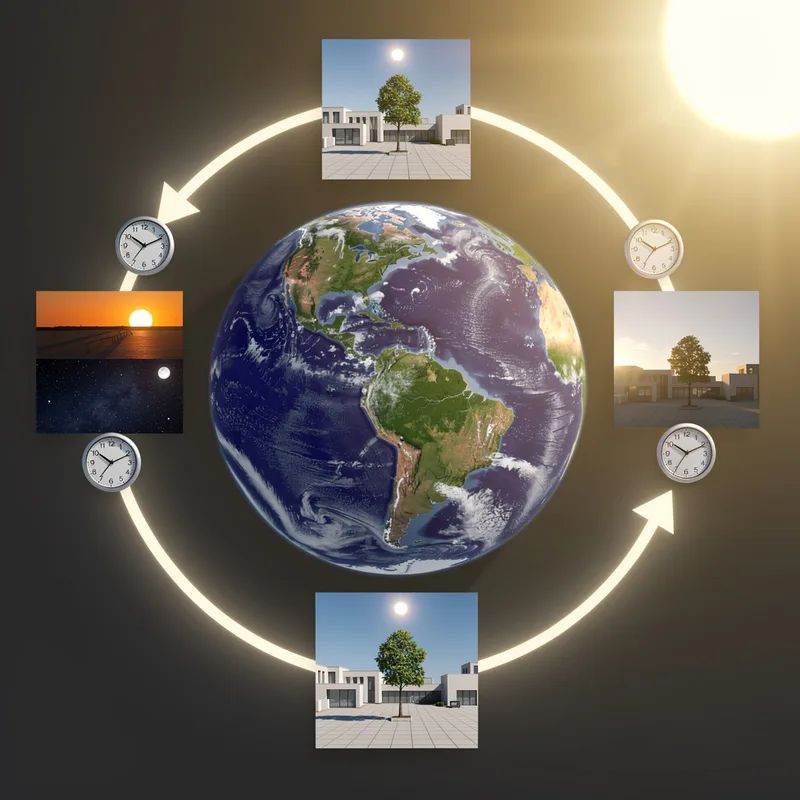
A solar day is based on the time it takes for the Earth to rotate fully, measured from one noon to the next.
-
The length of a solar day can vary slightly due to the Earth's elliptical orbit around the Sun.
-
To understand timekeeping, it is essential to note that a solar day lasts approximately 24 hours.
Synonyms
 ∞
1.0
∞
1.0
A period of 24 hours or the time a planet takes to turn once
 64
1.0
64
1.0
A period equal to one full day and night

Average time for Earth to turn once so the Sun appears in the same place, about 24 hours
Surface Forms
Morphology
The meaning — a day defined with respect to the Sun — is directly and compositionally built from 'solar' (pertaining to the Sun) + 'day' (a daily period), so a learner who knows both words can infer it refers to the day measured by the Sun (interval between noons). This adjectival+noun composition is common and cross-linguistically transparent, so it should be clear to a B1 learner.
Etymology
The term solar day, with solar meaning 'sun' and day meaning 'one turn', comes from the image of the Sun returning to the same place in the sky. It is the time from one 'noon' to the next, so it is about '24 hours' and is the kind of day we usually use.