
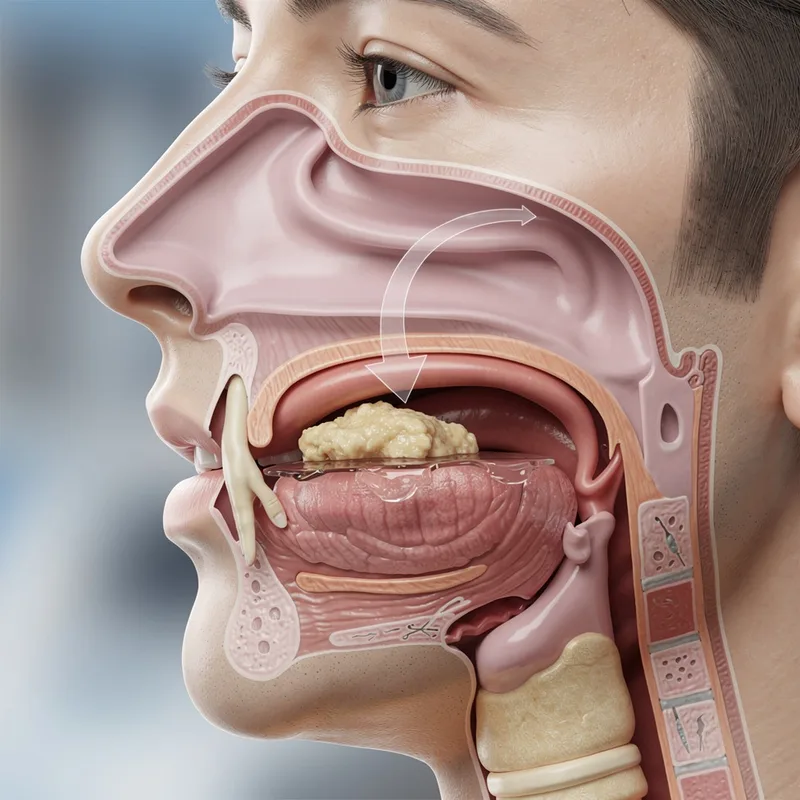
soft palate
 3
5.7
3
5.7

- noun
- /sɔft ˈpælɪt/
- Specialized
- The soft palate closes off the nasal passages when we swallow to prevent food from entering the nose.
- soft palate and uvula
- hard and soft palate
- midline soft palate
Examples
-
The uvula remained central, and the soft palate was full and bulging symmetrically.
Academic text (2005) -
PLGA usually occurs at the junction of the hard and soft palates.
Academic text (2005) -
Similar changes in the hard and soft palate are also characteristic of invasion.
Academic text (1995) -
The remaining patient had an isolated cleft of the soft palate.
Academic text (2015) -
The hemorrhage extended from the soft palate well into the mediastinum.
Academic text (2006) -
Some 22 months after the hemimandibulectomy, the patient noticed a painless mass in her soft palate.
Academic text (2003) -
Oral examination revealed a very large defect of the soft palate (Figure 1, B).
Academic text (2005) -
The procedure involves retracting the uvula toward the junction of the hard and soft palate.
Academic text (1999) -
Mild erythema of the soft palate without ulcerations or exudates was noted.
Academic text (2014) -
Socially disruptive snoring generally originates in the area of the soft palate and uvula.
Academic text (2008)
Synonyms


 1
9.9
1
9.9
A soft flap at the back of the mouth that lifts to close the nose when swallowing
Surface Forms
Morphology
The meaning — the pliable part of the palate — is directly and transparently derived from combining 'soft' (not hard, yielding) with 'palate' (the roof of the mouth). This straightforward adjective+noun composition follows a common, cross-linguistic pattern, so a B1 learner who knows both constituents will readily infer the MWE meaning.
Etymology
Soft palate names the soft, muscular part at the back of the mouth's roof, with soft meaning not hard and palate meaning the 'roof of the mouth'. When you swallow or speak, this part rises to close the way to the nose, so the name explains its job of keeping food out of the nose and helping make speech clear.