

skeletal muscle
 3
3.8
3
3.8

- noun
- /ˈskɛlɪtəl ˈmʌsəl/
- Specialized
- Physical activity is defined as any bodily movement produced by skeletal muscles resulting in energy expenditure.
- skeletal muscle tissue
- skeletal muscle development
- function in skeletal muscle
Loading YouTube…
Watch on YouTubeWe don't really store amino acids, although our muscle, skeletal muscle is kind of a reservoir for them.
- We don't really store amino acids, although our muscle, skeletal muscle is kind of a reservoir for them.
- Yeah, That completely misses the point at how critical skeletal muscle is and the role that it plays in medicine.
- You do not require insulin to move blood glucose out of the bloodstream into skeletal muscle tissue.
- So you need more of the blood vessels in order to supply the, the increase in in mitochondria within skeletal muscle.
- So we're shuffling all this blood to areas that we need to fight or run away from something the brain, the heart, the skeletal muscles, right?
- The rest of the muscle in our body is striated skeletal muscle.
- And who you become in that process of putting on skeletal muscle has a whole other impact.
- So if an individual is inactive and not exercising then that skeletal muscle becomes over packed.
- The the skeletal muscles involved in breathing are need neural input.
- You know, it's incredible how I, I took a class called skeletal muscle Structure, Function and plasticity.
- And by the way, M Tor is signalled by exercise in skeletal muscle as well, so it's not an M Tor issue in muscle.
Examples
-
The most common cuts of meat come from the skeletal muscles of animals.
Academic text (1999) -
We know that as we age, there are age-related changes to skeletal muscle and also to our bone.
-
Physical activity is "any bodily movement produced by skeletal muscles that results in energy expenditure."
Academic text (2012) -
Myasthenia gravis is a chronic autoimmune disease characterized by varying degrees of weakness of the skeletal muscles of the body.
Academic text (2007) -
Athletes develop strength in their skeletal muscles through intense training and regular exercise.
-
The doctor explained that injuries to skeletal muscles could lead to loss of mobility and strength.
-
To maintain healthy skeletal muscles, it is important to consume a balanced diet rich in protein.
Synonyms
 1
4.4
1
4.4
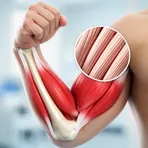
A type of body tissue with light and dark stripes that moves bones when you want
How Voluntary

Surface Forms
Morphology
The meaning 'a muscle attached to bones and responsible for moving the skeleton' is directly and transparently built from 'skeletal' (pertaining to the skeleton) + 'muscle' (body tissue that produces movement). The adjective+noun composition follows a standard, cross-linguistically common pattern, so a B1 learner who knows both constituents should be able to infer the MWE's meaning even if the term is somewhat technical.
Etymology
Skeletal muscle comes from the words skeletal, meaning 'skeleton' or bones, and muscle. These muscles attach to bones and pull on them to make the body move, so the name means 'muscles attached to bones'.