
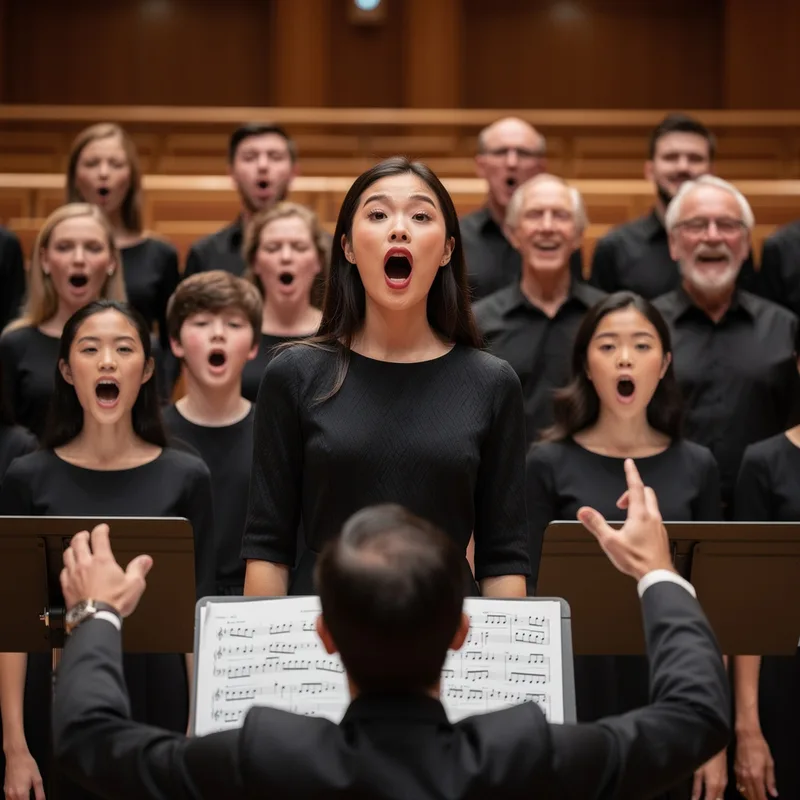
to sing soprano
 1
5.3
1
5.3

- phrasal verb
- /sɪŋ səˈprɑːnoʊ/
- During the concert, she will sing soprano as part of the opera chorus.
Examples
-
She sang in the Methodist Church choir and said she wanted to sing soprano "at the Met" when she graduated from high school.
Fiction book (1991) -
Like me, she was used to churches with "First" in their names—churches like my father's, where she sang soprano in the choir.
Fiction book (1999) -
Or we teach them how to sing soprano.
-
- Sing soprano, little man!
-
I'll have you singing soprano!
-
You'll end up singing soprano.
-
Because if your mother finds out just how fast it goes, I'm gonna end up singing soprano in the boy's choir.
-
Although I sang soprano in the church children's choir and never thought twice about singing high in elementary school, in middle school it was challenging for me to reach the high notes.
Academic text (2015) -
In the choir, he loves to sing soprano because it allows him to showcase his vocal range.
-
Last year, she decided to sing soprano for the school musical, impressing everyone with her high notes.
Antonyms

Surface Forms
Morphology
The meaning 'to perform the soprano vocal part' is a direct composition of 'sing' (use the voice to perform) and 'soprano' (the highest singing voice), so the overall sense is transparently derivable from the parts. This is a standard verb + role/part construction common across languages and registers, making it immediately understandable to a B1 learner who knows both constituents.
Etymology
The phrase sing soprano uses the verb sing and soprano, a word that means 'above', to picture a voice that sings the highest notes. So sing soprano means to sing the 'highest voice' or 'top part' in a choir.