

silicon dioxide
- noun
- /ˈsɪlɪkən daɪˈɒksaɪd/
- Specialized
- The sand on the beach is mostly made up of silicon dioxide, giving it its distinctive texture.
Examples
-
The regolith around here is mostly silicon dioxide, but it has a good deal of magnesium and aluminum oxides too.
Fiction book (1998) -
The organic film fills the 50 nm deep holes and extends 200 nm above the silicon dioxide film to form a two-dimensional planar waveguide.
Academic text (1999) -
So we've got this thin, thin silicon dioxide layer here that has been grown.
-
The patterns were increasingly produced by photolithography on a silicon dioxide surface layer grown on silicon.
Academic text (1993) -
When that secondary material is silicon dioxide, the graphene reacts when exposed to specific chemicals.
Blog text (29) -
Silicon dioxide could be grown in tightly adherent layers on silicon.
Academic text (1993) -
Technologically, silicon dioxide is one of the most important oxides known; it is the basis of isolation between active elements in transistor chips.
Academic text (1998) -
It is deposited on top of a silicon dioxide layer within which a triangular lattice of voids has been etched.
Academic text (1999) -
The process for making a microswitch involves depositing gold and chromium on an insulating substrate, such as glass or silicon coated with silicon dioxide.
Academic text (1997) -
Furthermore, silicon dioxide is a good (but not perfect) barrier to the diffusion of impurities at fabrication temperatures as well as at operating temperatures, so that it passivates the underlying structures.
Academic text (1993)
Synonyms
 12
7.3
12
7.3

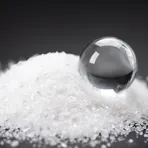
A hard white mineral like quartz found in sand and rocks used to make glass and ceramics

A hard white or clear material that makes up sand and glass
Surface Forms
Morphology
The term is fully compositional: 'silicon' (the element) plus 'dioxide' (an oxide with two oxygen atoms) directly yields the chemical SiO2, so a learner who knows both constituents can infer it is a compound of silicon and two oxygens. This follows regular chemical-naming patterns that are cross-linguistically similar, making the meaning transparent to B1 learners who know the parts.
Etymology
Silicon dioxide comes from the words silicon and dioxide, where 'di' means 'two' and 'oxide' means 'oxygen', so it literally names one silicon atom joined to two oxygen atoms. So, the word now refers to the hard, colorless, glass-like material you find in sand, quartz and glass.