
silicide


 1
9.9
- noun
- /ˈsɪlɪˌsaɪd/
- Specialized
- Jones Ion beam synthesis of silicides. White crystallization kinetics. Smith
- silicide synthesis
- properties of silicides
Examples
-
Fabrication and properties of iron silicides. Von Kanel
Academic text (1993) -
Turnbull, Structure of Glasses I. Navrotsky, Sales, Silicide Microstructures and Deformation.
Academic text (1993) -
There is a limit to increasing the fuel density of the uranium silicide fuel planned for the ANS.
Academic text (1994) -
Structural relaxation of glasses. Spaepen, Stebbins silicide synthesis and processing.
Academic text (1993) -
The 11 new topics for technical symposia this year include silicides, germanides, and their interfaces; developing materials processes.
Academic text (1993) -
Crystal nucleation. Greer Silicide mechanical behavior and problems. Sadananda, Gibala, Suresh.
Academic text (1993) -
Silicide oxidation and properties. Worrell Superconductivity and electronic structure II. Kuzmany, Shirley Superconductivity: Flux pinning and dynamics. Budhani, Gray.
Academic text (1993) -
Texture in polycrystalline films. Bilello: Grain boundary-dislocation interactions II. Thibault, Zhu: Novel silicide growth techniques. Ditchek: Properties of silicides. Ottaviani.
Academic text (1993) -
Texture in polycrystalline films. Bilello: Grain boundary-dislocation interactions II. Thibault, Zhu: Novel silicide growth techniques. Ditchek: Properties of silicides. Ottaviani.
Academic text (1993) -
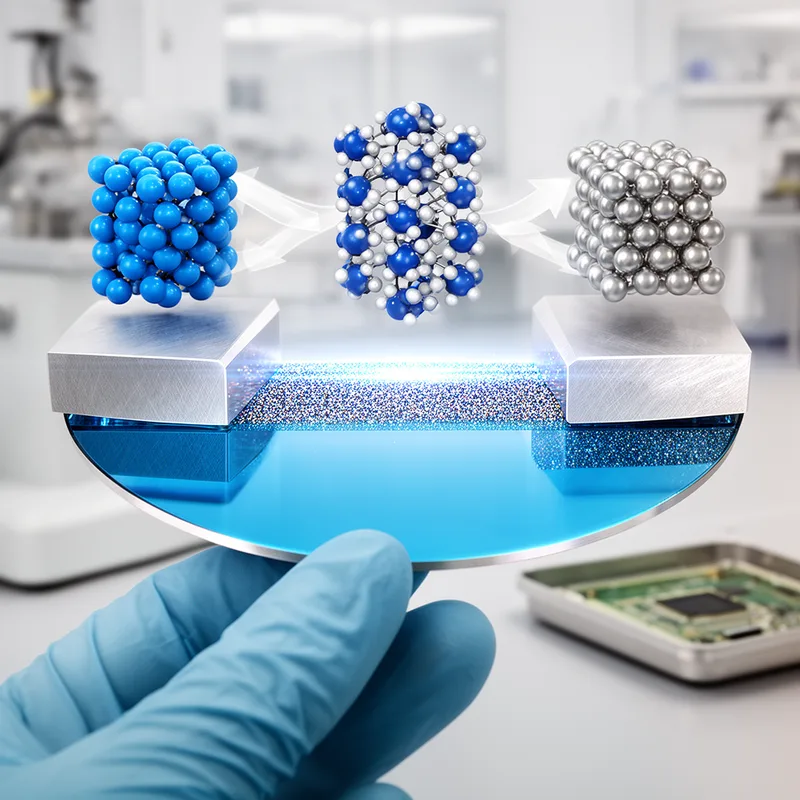
In the laboratory, the team discovered a new silicide that improved semiconductor performance.
Surface Forms
Morphology
silicide = silicon (semi-transparent) = silic + ide
Formed by the regular chemical naming pattern silicon + -ide, but recognizing '-ide' as indicating a binary compound requires specialized (chemistry) knowledge.
Etymology
The word silicide comes from silicon, the element in sand and computer chips, and the ending -ide, which means 'compound' in chemistry, as in 'oxide' or 'chloride'. So a silicide is simply a compound made of silicon and another element, which explains how the term is used for materials in electronics.