

to sign in
 58
1.8
58
1.8

- phrasal verb
- /saɪn ɪn/
- When you arrive at the event, make sure to sign in at the registration desk.
Loading YouTube…
Watch on YouTubeThen go to Fort Oregon, sign in, start getting paychecks.
- Then go to Fort Oregon, sign in, start getting paychecks.
- He had to sign in at Grey's police station.
- Great, yeah, it's asking me to sign in.
- I'm going so I could watch content that you had to be signed in to watch.
Examples
-
Don't forget to sign in and sanitize your hands.
-
All right, so now I'm going to I'm going to sign in with my other account.
-
Let me see if I can sign in and we'll do some problems.
-
And all I now need to do is to sign in with one of my many Google accounts.
-
- Just sign in here and go in.
-
It's time to sign in now.
-
Can everyone please sign in?
-
Enter and sign in, please.
-
But you do have to sign in.
-
So here you can just sign in with your Amazon credentials.
Synonyms
 603
2.8
603
2.8
To record information officially, for example names or events
 535
1.1
535
1.1
To register to take part in a competition or event
 136
1.6
136
1.6
To tell hotel or airport staff you have arrived and sign in
 55
3.0
55
3.0
Enter a computer system or website using your username and password
 44
2.7
44
2.7
Enter a computer or online account using your username and password
 3
3.5
3
3.5
Enter your user name and password to access a computer or online service
Antonyms

Surface Forms
Morphology
The meaning 'to register or record your arrival' is directly derivable from combining 'sign' (to write or affix your name) with 'in' (into/within); signing in literally means writing your name into a register or system. This verb+particle construction follows a common compositional pattern in English (and is paralleled in many other languages), so a B1 learner who knows both words will readily infer the MWE's meaning.
Etymology
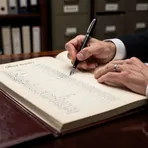
Sign in comes from the simple act of writing your name in a book when you enter a place. Here, sign means to write your name and in shows you are coming inside, so the phrase came to mean 'to register your arrival'.