
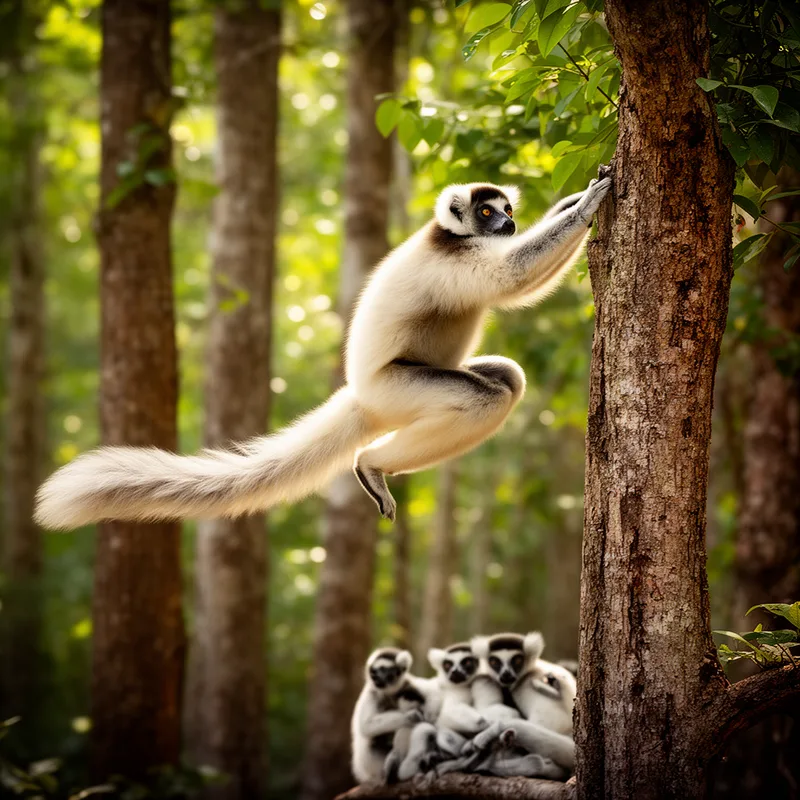
sifaka
 1
9.3

- noun
- /sɪˈfɑːkə/
- After breakfast, we look for brown lemurs, introduced to Berenty from western parts of the island, and creamy white/black-faced sifakas, which perform a bouncy hip-hop dance routine.
- Verreaux's sifaka
Examples
-
The sifaka is known for its incredible ability to leap between trees with its long tail.
-
Animal specimens were obtained from various species of ruminants and rodents, a horse, a raccoon, and a primate, Verreaux's sifaka (Propithecus verreauxicoquereli).
Academic text (2014) -
Most of the mammals are nocturnal, although the common ringtailed lemur and the sifaka can be seen during the day.
Academic text (1990) -
Remarkably, the females give birth at this time of year; nursing sifaka mothers produce very dilute milk and thus lose significant amounts of water during lactation.
Academic text (2000) -
Verreaux's sifaka (Propithecus verreauxi verreauxi)
Academic text (2000) -
The fragmented forests of Daraina, for example, are the last holdout of one of the world's most threatened primates, the golden-crowned sifaka.
Academic text (2006) -
Both it and the related sifakas use their powerful hind legs to leap 30 feet or more from tree to tree by pushing off backwards from one trunk, turning around in midair, and landing face-first on another.
Academic text (1993) -
PHOTO (COLOR): The new Makira and Ankeniheny-Zahamena conservation sites contain more than half of the known population of a number of threatened lemur species, including the diademed sifaka.
Academic text (2006) -
Verreaux's sifakas (Propithecus verreauxi verreauxi) are the most prominent inhabitants of Kirindy.
Academic text (2000) -
In Madagascar, the sifaka uses its powerful hind legs to jump from branch to branch.
Surface Forms
Etymology
Sifaka comes from the Malagasy name for the animal and copies the lemur's own call, heard like 'shi-fak'. So the name helps you remember this long-tailed lemur that leaps between trees in Madagascar.