

ship of the line
 1
9.9
1
9.9

- noun
- Archaic
- The four surviving French ships of the line will now attempt to fight their way clear.
- Spanish ships of the line
- French ships of the line
- gun ship of the line
Examples
-
The pasha of Egypt's army was to be limited to 18,000 men, and no ships of the line were to be built without the sultan's permission.
Academic text (2010) -
A court martial might decree for him death, disgrace, or ruin; the British public would not hear lightly of a British ship of the line surrendering, however great the odds against her.
Blog text (7) -
The four surviving French ships of the line will now attempt to fight their way clear.
-
They still indicated ships of the line.
Fiction book (1991) -
Each they may have been, but a single frigate was still engaged in a duel with three ships of the line twice its size.
-
He came in through the Delaware Capes on 8 July with 12 great ships of the line and four fast freighters.
Academic text (1992) -
Among their warships were the "ships-of-the-line," massively armed vessels that demonstrated the advantage of superior technology over superior numbers in modern warfare.
Academic text (1993) -
Victory, like all ships of the line, was ship rigged, meaning she had three masts, A foremast main mast, a Mizen mast and a bowsprit.
-
Admiral de Grasse is maneuvering 24 of our ships of the line into position.
-
On October 21, Nelson's 27 ships of the line faced 33 French and Spanish vessels.
Synonyms
 140
3.6
140
3.6
A navy boat built for fighting at sea
 1
5.3
1
5.3
A navy ship built to fight at sea
 1
9.9
1
9.9
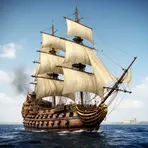
A large armed ship used by navies from the 1500s to the 1800s
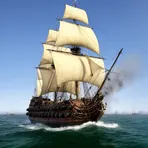
A large armed ship that uses sails and carries heavy guns before the mid 1800s
How Big
- Archaic
2
9.9

- Archaic
68
5.5
- Archaic
1
9.9
- Archaic
7
9.9
6
8.1
Surface Forms
Morphology
The phrase is partly compositional: a learner who knows 'ship' and the notion of a 'line' in battle can infer it denotes a warship used in the battle line, so a basic sense (a type of warship for line-of-battle fighting) is recoverable. However, it is a technical/historical naval term with specific functional and chronological implications that are not fully predictable from the constituents alone, and learners unfamiliar with the naval sense of 'line' may not grasp the exact meaning.
Etymology
The noun ship of the line comes from the way large war ships sailed in a single long row called the 'line of battle', so each ship in the line could fire the guns on its side at the enemy. That's why the phrase means a big warship meant to fight in the 'line of battle'.