

sheet bend


 1
8.4
1
8.4
- noun
- /ʃiːt bɛnd/
- Jargon
- To join the climbing rope to the harness, the instructor demonstrated how to tie a sheet bend correctly.
Examples
-
The sailor used a sheet bend to securely connect the two ropes while adjusting the sail.
-
It's a sheet bend knot.
-
Pull on a bowline (or a sheet bend) the wrong way, and it becomes unstable, tumbling or untying itself, and alarmingly so for a knot considered safe.
Academic text (2009) -
For the fishing line, make sure to use a sheet bend to attach it securely to the main line.
Synonyms
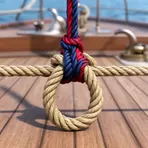
A knot that ties one rope to the middle of another rope or to a loop

A knot for tying one rope temporarily to the middle of another rope or to a loop

To tie one rope or thread temporarily to the middle of another rope to join them

A strong knot for joining the ends of two thick ropes

A strong knot used to join the ends of two large ropes often on ships
How Secure
- Specialized

- Specialized
1
6.1
- Jargon
1
8.4
- Specialized
1
4.4
Surface Forms
Morphology
Although 'sheet' (here a rope) and 'bend' (a curve) give a surface-level compositional link — essentially a curve in a rope — the specific technical meaning of 'bend' as a knot for joining ropes is domain-specific and not predictable for an average B1 learner. Learners with nautical or knotting knowledge may infer that it names a knot, but most learners who only know the common senses would need prior exposure, so the transparency is partial.
Etymology
Sheet bend comes from sailing: sailors called the rope that held a sail a sheet, and the old word bend meant 'to tie'. So the name describes a knot used to tie a sheet to another rope, and that's why the sheet bend means a knot for joining two ropes, even when they are different sizes.