
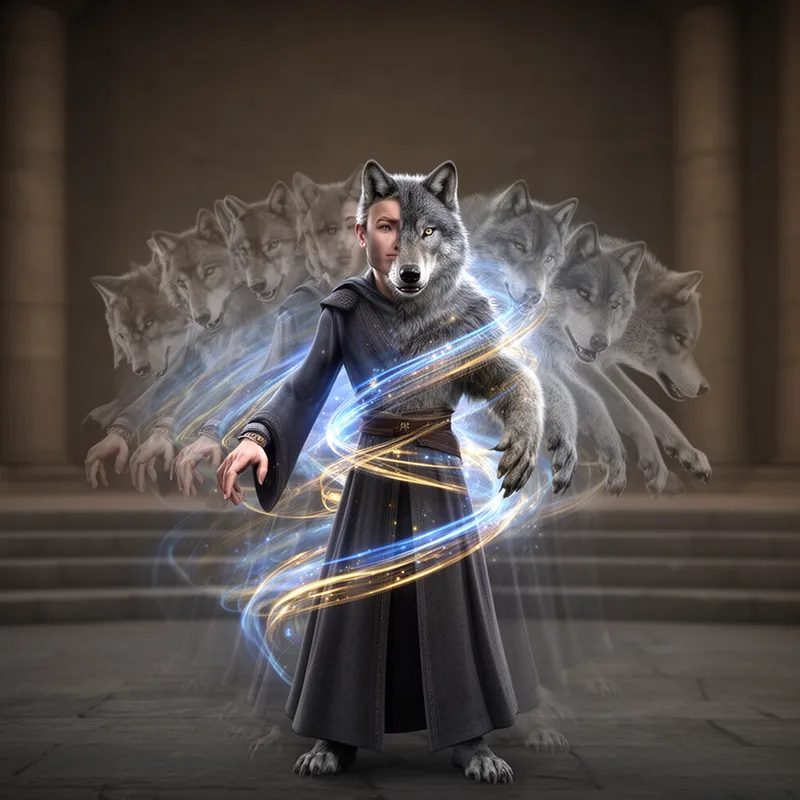
to shapeshift into
- phrasal verb
- /ˈʃeɪpˌʃɪft ˈɪntu/
- Literature
- The wizard shapeshifted into a dragon to scare the villagers.
Examples
-
Stories often describe gods who shapeshift into humans to walk among mortals.
-
In many myths, a powerful wizard can shapeshift into an animal at will.
-
The villain shapeshifted into a shadow to escape detection.
-
He can shapeshift into a wolf at will.
-
The wizard can shapeshift into any creature he desires, confusing his enemies.
-
In the story, the ancient spirit is able to shapeshift into various animals at will.
-
During the full moon, the creature would shapeshift into a wolf and roam the forest.
Synonyms

 ∞
1.0
∞
1.0

Start to change into a different state or role
 890
2.2
890
2.2
To change into something different or make something change
 523
3.4
523
3.4
Change something a lot so it looks or works very differently
 76
5.8
76
5.8
To change smoothly from one form to another
 9
3.6
9
3.6
To become a different shape
 8
7.5
8
7.5
To change something into a different form or material
 5
8.2
5
8.2
Change completely in form or appearance
 4
3.9
4
3.9
To become a different shape or look
 3
9.9
3
9.9
To change something into a very different form, often as if by magic
 3
8.6
3
8.6
To change your body or look into another form, often an animal
How Complete
5
8.2
 8
7.5
8
7.5
- Literature
890
2.2
88
3.8
∞
1.0
Surface Forms
Morphology
The verb 'shapeshift' already means to change physical form and the preposition 'into' clearly indicates the target form, so the combined meaning 'transform oneself into X' is directly compositional. This follows the common change-of-state verb + into pattern found across languages, making it immediately understandable to learners who know both constituents.
Etymology
Shapeshift into comes from old stories where gods, witches, or spirits could change their shape and shift into animals or other people, like putting on a new body. So it means 'to change into another form', usually by magic.