
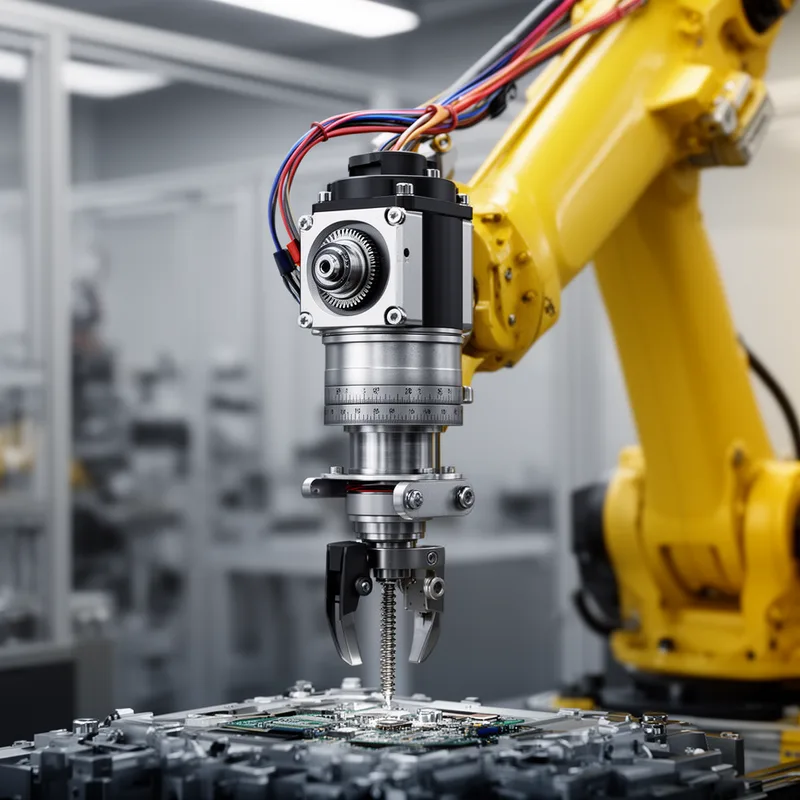
servomotor


 1
7.2
1
7.2
- noun
- /ˈsɜrvəˌmoʊtər/
- Specialized
- To position the robotic arm accurately, a servomotor is used to adjust its angles.
- brushless servomotor
- DC servomotor
- servomotor control
Examples
-
The KIN-COM consists of a servomotor-controlled rotary arm with an attached load cell.
Academic text (1997) -
Each arm is driven by a small servomotor.
Academic text (2007) -
For the controller, this was accomplished by using a PC-based servomotor controller.
Academic text (1992) -
Add an encoder and a controller, and you get positional control in the form of a DC brush servomotor.
Academic text (2003) -
Inside the controller of our DC brush servomotor, for instance, electronics compute the position/velocity error.
Academic text (2003) -
To maintain motor integrity at high bus voltages, the servomotors feature a 600-V-UL winding-insulation system.
Academic text (1996) -
The Platinum XT series is a three-phase brushless DC servomotor that uses armature technology.
Academic text (1996) -
The left foot and knee were secured to a platform to which a servomotor (Model 305B, Aurora Scientific, Aurora, Ontario, Canada) was attached.
Academic text (2005) -
Both stepper and closed-loop DC servomotors are offered with integrated noncontacting limit switches and homing sensors.
Academic text (2006) -
Sentry brushless servomotors are available in NEMA and metric mounting with UL and European compliance ratings.
Academic text (1996)
Synonyms
 69
6.0
69
6.0
A person, force, or thing that causes action
 5
7.4
5
7.4
A device that makes a machine move or work when it gets a signal
 3
8.1
3
8.1
A motor that turns in tiny, exact amounts to move parts precisely
How Precise

Surface Forms
Morphology
Etymology
The word servomotor comes from the parts servo (from a Latin word meaning 'servant' or 'helper', like the English word serve) and motor (from a word meaning 'move' or 'mover'). So a servomotor is a motor that 'serves' to control movement exactly, which is why we use it in robots and machines that need precise positions.