

serial music
- noun
- /ˈsɪəriəl ˈmjuːzɪk/
- Specialized
- The use of serial music allowed artists to explore new sonic territories and create unique compositions.
Examples
-
In this, Cage could have agreed with Adorno, who noted: "In serial music, this dialectic is taken to extremes."
Academic text (1997) -
If you look at Europe in the '60s and '70s, many composers took the approach of serial music.
Blog text (23) -
Many 20th-century composers embraced serial music as a way to break free from traditional tonal structures.
-
Critics often debated the merits of serial music, citing its complex organization of notes as either innovative or overly rigid.
Synonyms


 1
9.9
1
9.9
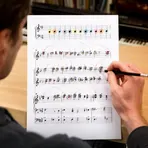
A way of writing music that uses a fixed order of notes
Surface Forms
Morphology
The phrase transparently combines 'serial' (relating to a series) and 'music', so a learner could guess it refers to music organized by series; however, the precise meaning — a specialized 20th-century compositional technique using ordered tone rows — is technical and not directly predictable from the constituents by an average B1 learner. Because it is a domain-specific label that requires musical knowledge beyond the literal words, it is only partially transparent.
Etymology
Serial music comes from the idea of following a set order of notes, like a 'list' or 'recipe' a composer must follow. So, serial music means music made from that same fixed order of notes, which is why it can sound different from regular songs.