

seraglio


 1
9.9
1
9.9
- noun
- /səˈræl.joʊ/
- Archaic
- Yet Fabrice's ebullient remark to a different correspondent that "a fine seraglio is being prepared at Adrianople, or in its neighborhood, for the King" could also suggest a brand-new construction.
Examples
-
The Seraskier has caused to be built a kind of seraglio for the King, which has very much the air of one of our small farms in Holstein, only that it is painted with a great variety of colors and has a wooden roof.
Academic text (2003) -
Visitors frequently made reference to women residing at the royal residences, although their understanding of the king's "seraglio" was very limited.
Academic text (1991) -
"We must discuss the upcoming Grand Seraglio competition.
Fiction book (1996) -
The right corner is occupied by a large building that serves as an infirmary to all those who live in the Seraglio.
Academic text (2003) -
One is immediately reminded of Fabrice's brief but clear description of the second court at Topkapi: "People are admitted only into the 2d court of the seraglio, and are hindered from going further by a guard of black Eunuchs."
Academic text (2003) -
As for the buildings which compose the body of the Seraglio, there is no regularity of architecture nor any symmetry observed in it; but it is a heap of uneven houses separated from one another in the nature of tents.
Academic text (2003) -
In Ottoman times, the seraglio served as the private living quarters for the sultan's wives and female relatives.
-
Visitors often marveled at the luxurious decorations within the seraglio, where the royal women resided.
-
The historical seraglio is a symbol of the sultan's power and privilege in the Ottoman Empire.
Synonyms
 32
8.2
32
8.2
The part of a Muslim home where wives and other women live apart from men
 1
9.9
1
9.9
A private part of a Muslim household where women live apart from men
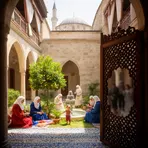
A private part of a Muslim household, traditionally where the man's wives and female relatives live separately

A private part of a Muslim home where women live and men do not enter
Surface Forms
Etymology
Seraglio comes from the Turkish and Persian word saray meaning 'palace', and it came into Italian as a word for an 'enclosed' part of that palace. So a seraglio is the private area where a ruler's wives and female relatives lived.