
selenide


 1
9.3
- noun
- /ˈsɛlɪnaɪd/
- Specialized
- Louis Brus and his colleagues at AT&T Bell Laboratories have synthesized cadmium selenide clusters containing hundreds to thousands of atoms over a range of average diameters in the nanometer regime.
- cadmium selenide
- gallium selenide
Examples
-
Cadmium selenide is widely used in semiconductor technology due to its unique optical properties.
-
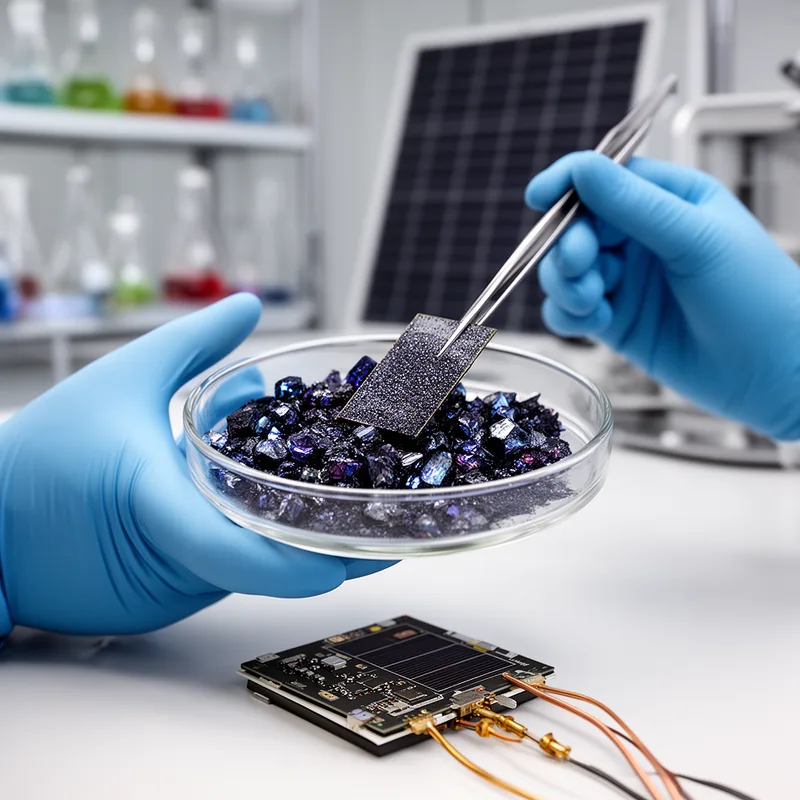
And what you are seeing here is actually a suspension of cadmium selenide nanoparticles.
-
And also copper, Indium, gallium selenide can give you that band gap.
-
A research group at 3M Company has made tremendous progress and recently demonstrated a semiconductor laser made from the zinc selenide material system that could emit light in the 430-nm range.
Academic text (1996) -
Gary Prinz of the Naval Research Laboratory in Washington, D.C., adds that Butler also predicted that zinc selenide would be a good spin-discriminating barrier between iron layers.
Academic text (2004) -
Researchers are exploring the use of gallium selenide in new solar cell designs for improved efficiency.
-
The lab synthesized a new form of selenide that demonstrates enhanced conductivity for electronic applications.
Surface Forms
Morphology
selenide = selenium (semi-transparent) = selen + ide
Formally derived from the element name 'selenium' with the chemical suffix '-ide', which is systematic in chemistry but requires domain knowledge unfamiliar to average learners.
Etymology
Selenide comes from the element name selenium, which itself comes from the Greek selene, meaning 'moon'. The ending -ide is a common chemistry ending meaning 'a compound of'. So a selenide is a compound made with selenium, which is why the word refers to a chemical often used in electronics and solar cells.