

secular games
- noun
- /ˈsɛkjələr ɡeɪmz/
- Literature
- Every hundred years, the Romans held the secular games.
Examples
-
During the secular games, citizens witnessed both religious rituals and public entertainments.
-
The emperor presided over the secular games, celebrating Rome's new era with elaborate ceremonies.
-
Historical accounts describe the secular games as grand events drawing crowds from across the Roman Empire.
-
The secular games were celebrated with great enthusiasm.
-
Historical accounts describe the secular games as grand events drawing crowds from across the Roman Empire.
-
During the secular games, citizens witnessed both religious rituals and public entertainments.
-
The emperor presided over the secular games, celebrating Rome's new era with elaborate ceremonies.
Synonyms
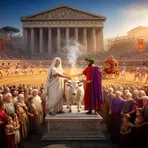
Religious games held in ancient Rome about every hundred years to mark a new generation
Surface Forms
Morphology
The modern senses of the constituents ('secular' = not connected with religion; 'games' = contests) would lead a learner to expect 'non-religious contests', which is the opposite of the historical meaning. The term 'secular' here derives from Latin saeculum (a generation/century) and denotes a specific, culture-historical centennial religious rite in ancient Rome, so the overall meaning is historically specific and not predictable from the contemporary constituent meanings.
Etymology
Secular games comes from ancient Rome, where special religious ceremonies and public shows were held once every hundred years to mark the start of a new generation. The word secular came from an old Latin word meaning 'a long time' or 'a generation', so secular games are festivals that celebrate the start of a new era.

