
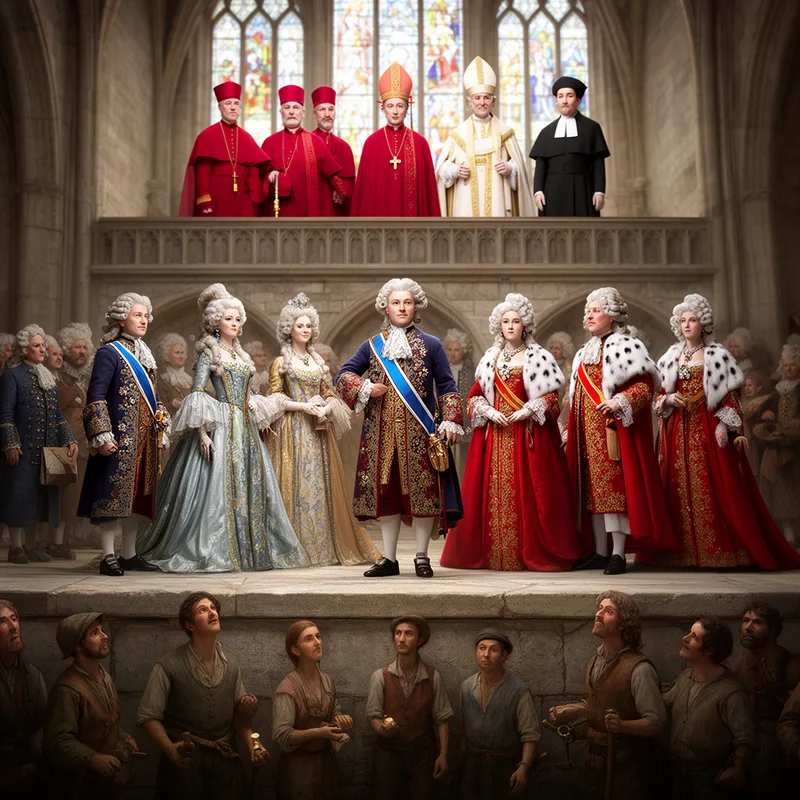
second estate
- noun
- Formal
- Before the French Revolution, the second estate consisted of nobles who held significant power and privileges.
Examples
-
Jean Meyer estimates that the 6,000 houses recorded in 1668 fell to 4,000 by 1696 as the monarchy sought to limit the numbers of the second estate.
Academic text (2018) -
The second estate in Britain includes the peerage, ranking just below the clergy in terms of social status.
-
The cleric of Misericordia, Dol Romualdo Cedron, cannot be deemed to represent the priesthood or second estate in the way a priest would in the epoch of culture.
Academic text (1992) -
Members of the second estate often influenced laws and governance in pre-revolutionary France.
Synonyms

 3
8.9
3
8.9

A group of people with noble titles in the United Kingdom
Surface Forms
Morphology
The meaning is directly compositional: 'second' (following the first in rank) combined with 'estate' (a social class) clearly signals the class ranked after the first estate (the clergy), i.e. the nobility. This ordinal + social-class construction is transparent and parallels similar formulations in other languages, so a B1 learner who knows the constituents can infer the MWE meaning.
Etymology
The term second estate comes from old Europe, where society was split into three groups called estates, with the church as the first, the nobles as the second, and the common people as the third. Because the nobles had special rights and power, second estate came to mean 'the class of nobility'.