

to search for prey
- phrasal verb
- It can search for prey with two tentacles without even surfacing.
Examples
-
An eagle gracefully soars above the forest as it searches for prey to feed its young.
-
Nellie watches for that ship like an eagle searches for prey.
Fiction book (1999) -
Right now, the mob was an aimless, angry animal searching for prey.
Fiction book (1996) -
By 3:46, we had accounted for all six members of the group, which had divided into teams and were apparently searching for prey.
Academic text (1990) -
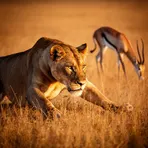
The lion quietly searches for prey across the savannah, using the tall grass for cover.
-
As night falls, the owl searches for prey in the darkness, relying on its keen hearing.
Synonyms

 ∞
1.0
∞
1.0

Try to find or get something you want
 367
1.4
367
1.4
To chase and kill wild animals for food or sport
 41
6.0
41
6.0
To move quietly and carefully while looking for animals to catch
 22
4.9
22
4.9
To search widely for food in the wild

To search in fields and woods for food and useful items
How Active

Surface Forms
Morphology
The meaning 'to look for animals to hunt' is directly derivable from combining 'search' (to try to locate) with the preposition 'for' (indicating target) and 'prey' (animals hunted). This straightforward verb + preposition + object construction is cross-linguistically common and follows regular English composition patterns, so a B1 learner who knows the constituents will readily understand it.
Etymology
The verb phrase search for prey comes from a simple hunting picture: an animal that hunts, like a lion or an owl, quietly searches for other animals, its prey, to eat. So the phrase means 'to look for animals to hunt and eat'.